
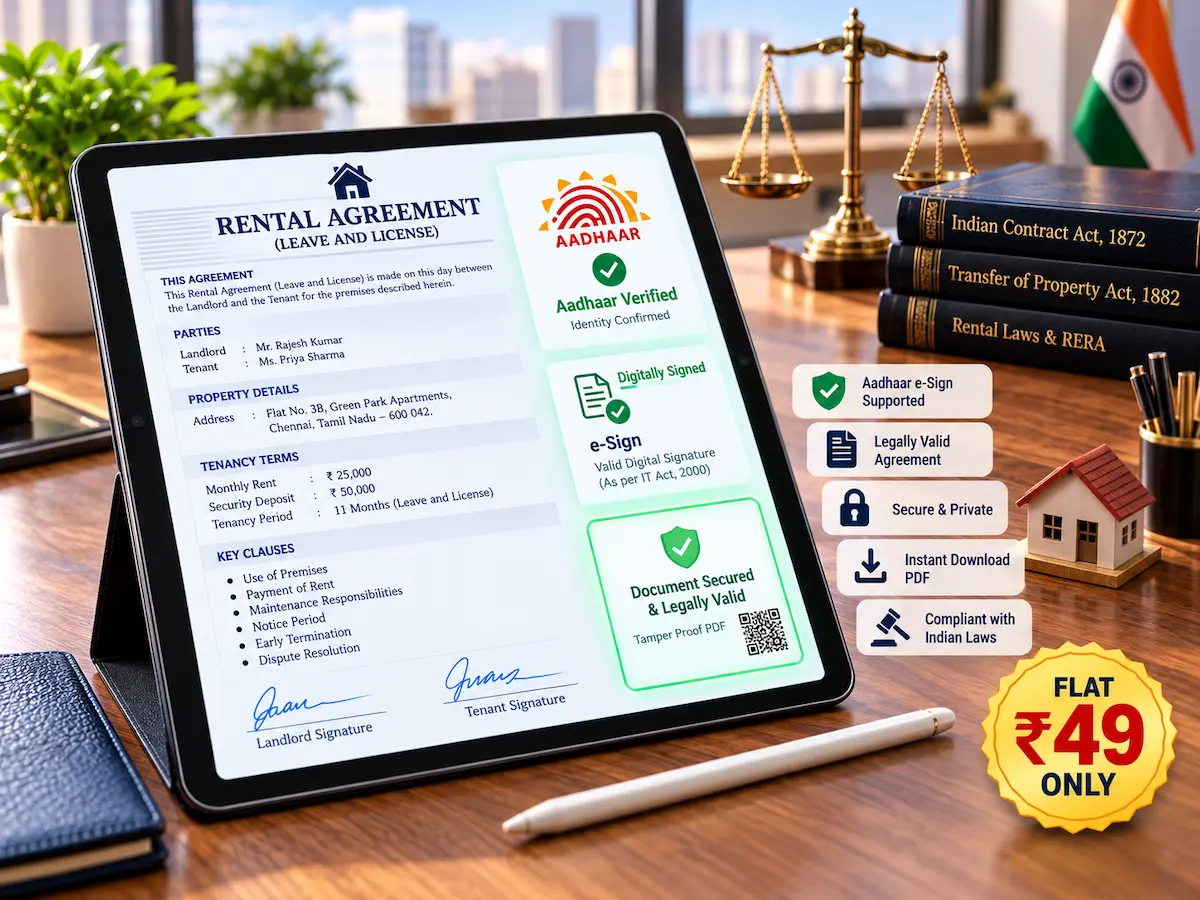
In today's hyper-connected, digital-first economy, virtually every routine transaction in India—from stock trading and banking to booking flight tickets and income tax filing—has transitioned seamlessly to paperless workflows. Naturally, property owners and tenants across urban metropolises like Bangalore, Mumbai, Delhi-NCR, Hyderabad, and Chennai, as well as Non-Resident Indians (NRIs) living abroad, frequently ask:
"Can we execute our rental agreement digitally using an Aadhaar e-Sign, DocuSign, or Digital Signature Certificate (DSC), or does Indian law still require a physical pen-and-paper wet-ink signature on stamp paper?"
The short answer is: Yes, electronic signatures on rental agreements are legally recognized under the Information Technology Act, 2000 (IT Act)—BUT only if specific statutory conditions regarding stamp duty and document registration are rigorously satisfied.
Many individuals make the catastrophic mistake of pasting an unverified scanned PNG image of their signature onto a Word document and assuming they have an airtight, enforceable contract. In an Indian court of law, that document will likely be rejected under the Indian Stamp Act, 1899 and the Registration Act, 1908.
In this comprehensive 2026 legal guide, we analyze the provisions of the Information Technology Act (Sections 5 and 10A), compare Aadhaar e-Sign vs Class 3 DSC tokens vs wet-ink signatures, untangle the mandatory state stamp duty requirements, and explain how to draft a court-admissible agreement on LetOutAgree for flat ₹49.
Generate a Legally Compliant Rental Agreement in Minutes
Stop wondering about digital validity. Generate an attorney-vetted agreement tailored for immediate e-stamping, valid signatures, and airtight court enforceability for flat ₹49.

The Statutory Legal Framework: Information Technology Act, 2000
The primary statute governing electronic contracts and digital signatures in India is the Information Technology Act, 2000 (amended in 2008). Three critical sections form the foundation of electronic agreements:
1. Section 10A: Validity of Contracts Formed Through Electronic Means
Section 10A of the IT Act explicitly provides:
"Where in a contract formation, the communication of proposals, the acceptance of proposals, the revocation of proposals and acceptances, as the case may be, are expressed in electronic form or by means of an electronic record, such contract shall not be deemed to be unenforceable solely on the ground that such electronic form or means was used for that purpose."
This statutory provision establishes beyond doubt that entering into a contract via electronic means (such as online portals, digital forms, and authenticated electronic files) is 100% legally recognized in India.
2. Section 5: Legal Recognition of Electronic Signatures
Section 5 of the IT Act equates a recognized electronic signature with a traditional handwritten (wet-ink) signature:
"Where any law provides that information or any other matter shall be in writing or in the typewritten or printed form, then, notwithstanding anything contained in such law, such requirement shall be deemed to have been satisfied if such information or matter is rendered or made available in an electronic form and accessible so as to be usable for a subsequent reference."
3. The First Schedule Exclusion List: Does a Rental Agreement Qualify?
The First Schedule of the IT Act lists specific legal documents that CANNOT be executed electronically (they strictly require traditional physical execution):
- Negotiable instruments (like promissory notes or cheques, other than electronic cheques).
- Powers of Attorney.
- Trust deeds.
- Wills and testamentary dispositions.
- Contracts for the sale or conveyance of immovable property or any interest in such property.
Crucial Distinction: An 11-month Leave and License Agreement does not transfer any proprietary interest in immovable property—it grants only a personal, revocable permission to occupy under Section 52 of the Indian Easements Act, 1882. Therefore, 11-month Leave and License agreements are NOT excluded by the First Schedule and can be validly executed electronically under Indian law!
The 3 Types of Signatures Used in India: Validity Scorecard
Not all "digital signatures" carry the same legal weight. Indian courts draw clear distinctions between authenticated electronic signatures and unverified images:
| Signature Type | Technical Mechanism | Legal Validity under IT Act | Court Admissibility |
|---|---|---|---|
| 1. Aadhaar eSign | One-time OTP or biometric e-KYC authentication via a licensed Certifying Authority (ESP) like NSDL, eMudhra, or C-DAC. | 100% Recognized (Section 3A of IT Act) | High. Carries statutory presumption of authenticity under Evidence Act. |
| 2. Digital Signature Certificate (DSC) | Asymmetric cryptographic public-private key pair stored on a hardware USB crypto token (Class 3 DSC). | 100% Recognized (Section 2(p) & Section 3 of IT Act) | Highest legal sanctity. Tamper-evident and verifiable via public key infrastructure. |
| 3. Pasted Image / Scanned Signature | Pasting a cropped PNG or JPEG image of a handwriting signature onto a PDF document. | NOT Recognized as a Secure Signature | Very Low. Easily repudiated; courts view it as easily forged or copied without consent. |
| 4. Traditional Wet-Ink Signature | Signing physically on printed A4 paper attached to original state e-Stamp certificate. | Gold Standard under Indian Law | Universally accepted by all civil courts, banks, police stations, and government bodies. |
The Elephant in the Room: The Mandatory Stamp Duty Hurdle
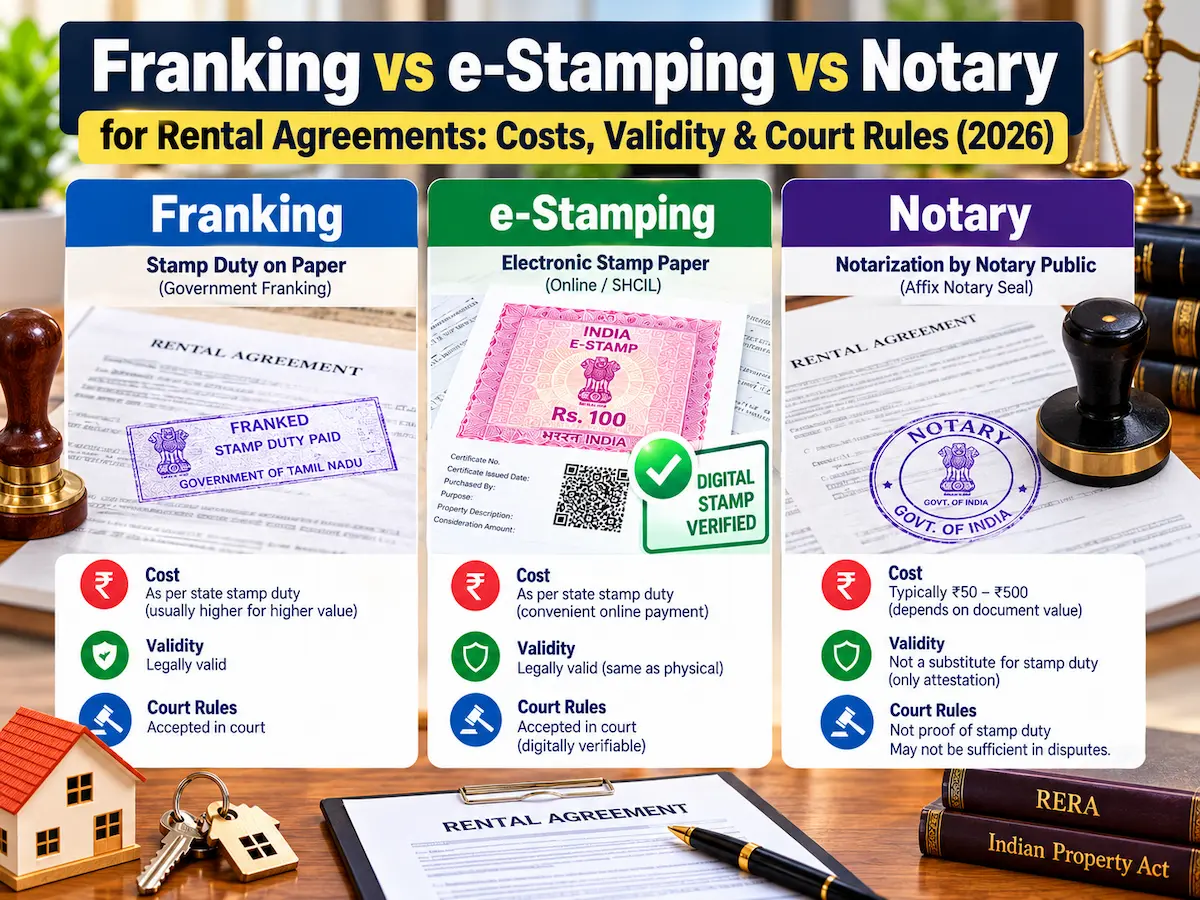
While the IT Act validates the electronic nature of a contract, it does NOT exempt the contract from state stamp duty. This is where most digital agreement users make a fatal legal blunder.
Under Section 35 of the Indian Stamp Act, 1899:
"No instrument chargeable with duty shall be admitted in evidence for any purpose by any person having by law or consent of parties authority to receive evidence, or shall be acted upon, registered or authenticated by any such person, unless such instrument is duly stamped."
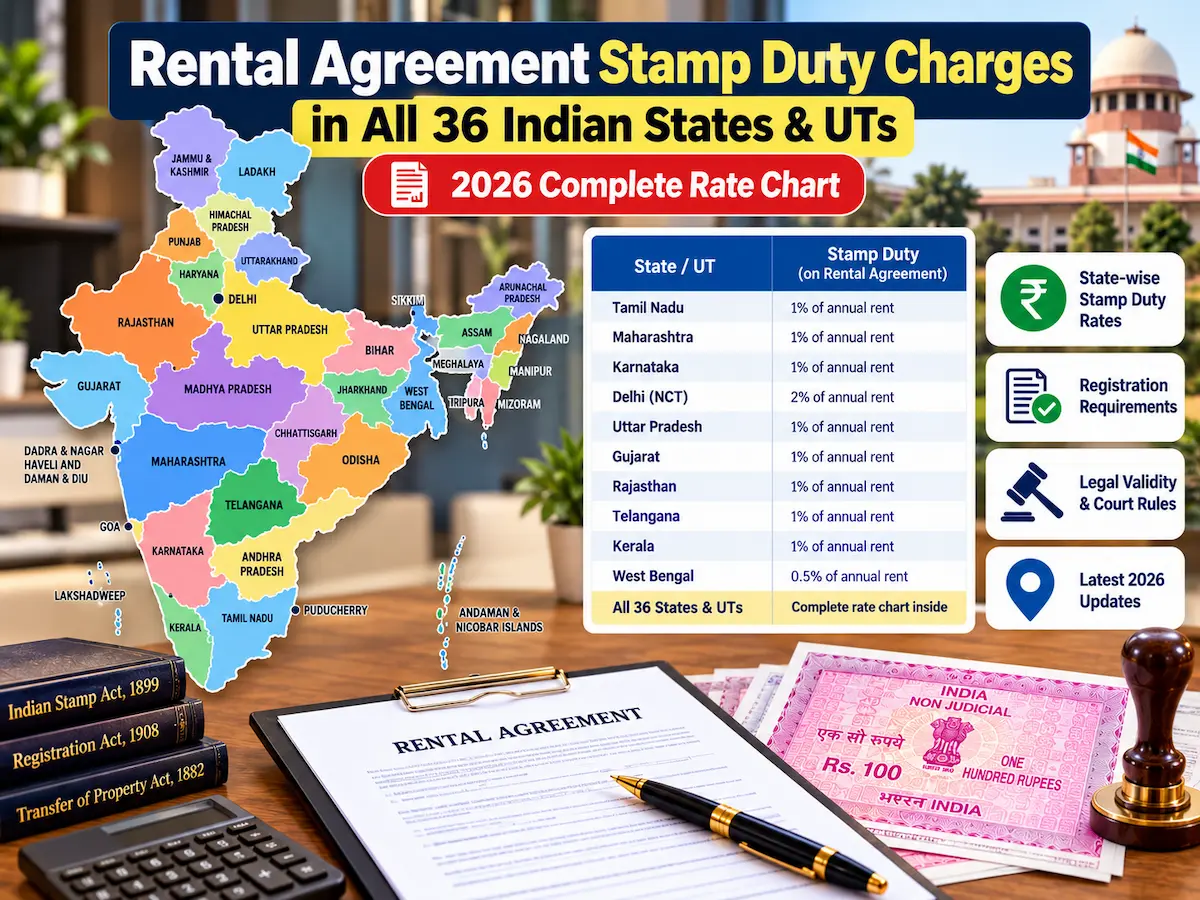
The Legal Consequence: Even if your rental agreement is signed with the world's most sophisticated cryptographic digital signature, if proper state stamp duty (e.g., ₹100, ₹200, or ₹500 depending on your state) was not paid into the state treasury, the agreement is legally inadmissible as evidence in court! To enforce it, you will have to pay the unpaid stamp duty plus a crushing penalty of up to 10 times the deficit stamp value.
How to Legally Combine Digital Drafting with Stamp Duty Compliance
To achieve 100% legal validity, enforceability, and hassle-free acceptance across all government and banking institutions in India, seasoned legal professionals follow one of two compliant workflows:
Workflow A: The Hybrid Workflow (Most Recommended & Universally Accepted)
- Draft Online: Generate your customized, attorney-vetted agreement on LetOutAgree for flat ₹49.
- Procure e-Stamp Paper: Purchase the state-mandated e-Stamp certificate (from SHCIL, registered bank branch, or licensed stamp vendor; see our State-Wise e-Stamp Paper Guide).
- Print & Wet-Ink Sign: Print the LetOutAgree PDF on clean A4 paper, attach the e-Stamp certificate as the first page, and sign with pen in the presence of two witnesses.
- Scan for Digital Records: Scan the complete executed document. Both parties retain digital PDF copies for HRA proof, police verification, and bank KYC, while retaining the physical stamped original.
Workflow B: Fully Digital Execution via Integrated e-Stamping + Aadhaar eSign
- The digital platform integrates directly with state online stamping servers (e.g., NeSL / SHCIL digital e-stamping).
- A digitally generated e-Stamp certificate with a verifiable Certificate Identification Number (CIN) is electronically merged with the agreement text.
- Both landlord and tenant authenticate their identity and execute the document using UIDAI Aadhaar OTP eSign.
- Under Section 65B of the Indian Evidence Act / Section 63 of Bharatiya Sakshya Adhiniyam, 2023, the electronic audit trail and cryptographic hash serve as conclusive proof of execution.
What About Sub-Registrar Office (SRO) Registration?
Does a digital signature allow you to bypass physically visiting the Sub-Registrar Office (SRO)? It depends strictly on your tenancy tenure and state jurisdiction:
- Tenancy of 11 Months or Less: As detailed in our guide on Why Rental Agreements Are Signed for 11 Months, agreements for 11 months do not require compulsory registration under Section 17(1)(d) of the Registration Act in most states (except Maharashtra). For these agreements, properly stamped electronic contracts are fully self-sufficient.
- Tenancies Exceeding 11 Months: If a lease runs for 12 months, 3 years, or 5 years, Section 17 makes SRO registration mandatory. Except in states like Maharashtra (which provides a dedicated e-Registration portal using biometric Aadhaar scanners), most Indian states still require physical appearance of both parties before the Sub-Registrar to register multi-year leases.
Draft a Court-Compliant Agreement on LetOutAgree
Whether you choose to print and wet-ink sign on physical e-Stamp paper or utilize digital workflows, the legal enforceability of your contract starts with the precision of the text. Flimsy free templates lack essential jurisdiction clauses, tamper-proof recital structures, and state stamp compatibility.
LetOutAgree gives you an attorney-grade legal foundation in less than 3 minutes:
- Select Agreement Category: Choose Residential Rental Agreement or Commercial Shop Lease.
- Enter Verified Details: Landlord particulars, tenant KYC details, rent schedule, security deposit terms, and notice periods.
- Free Live Screen Preview: Read and verify the entire legal draft on your screen before paying anything.
- Flat ₹49 Instant Download: Pay securely via UPI, QR, or Card to immediately receive your high-resolution A4 print PDF calibrated for state e-Stamp certificate attachment.
- Court, Bank & Police Verification Approved: Submit with confidence for company HR HRA tax claims, banking KYC, and tenant police verification.
This article is for informational purposes only and does not constitute legal advice. Please consult a qualified legal professional for advice specific to your situation.


Comments (0)
Login to leave a comment.