
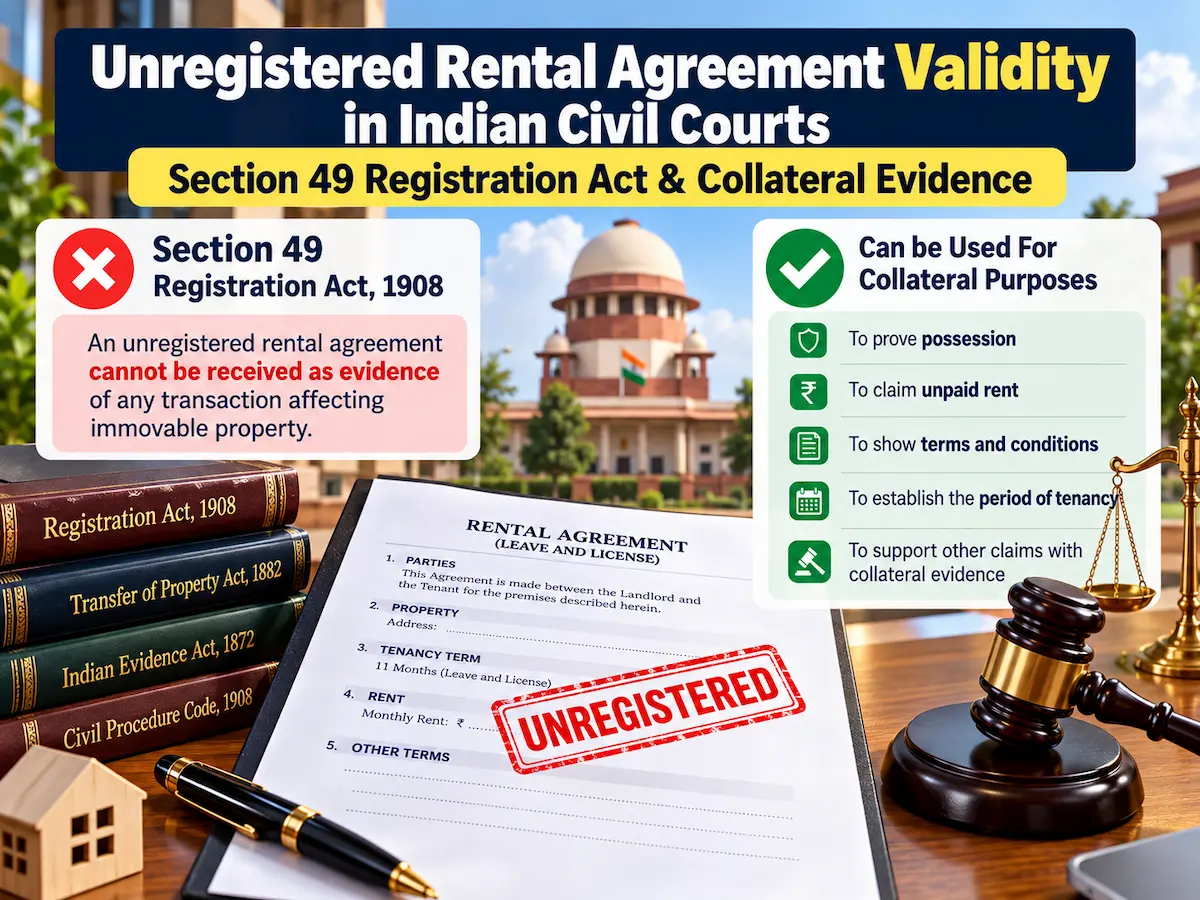
In Indian property litigation, few statutory provisions spark more heated courtroom battles than Section 49 of the Registration Act, 1908. When a tenancy dispute escalates to an eviction suit, unpaid rent recovery, or security deposit forfeiture, landlords and tenants routinely confront a chilling legal question: If our rental agreement was never registered at the Sub-Registrar's Office, can it be produced as evidence before a civil judge or Rent Authority?
Common street wisdom suggests that an unregistered agreement is "completely useless" in court. However, Indian property jurisprudence is far more nuanced. While an unregistered document that requires compulsory registration cannot establish a long-term leasehold title, the proviso to Section 49 carves out a vital legal lifeline: it can be admitted in evidence for 'collateral purposes'.
In this authoritative 2026 legal guide, we examine landmark Supreme Court judgments, decode the statutory boundaries between Section 17 and Section 49, and clarify exactly when an unregistered 11-month or multi-year agreement can be used to protect your rights.
Table of Contents
- The Statutory Rule: Section 17 vs. Section 49
- The 'Collateral Purpose' Exception Under Section 49 Proviso
- Landmark Supreme Court Rulings (K.B. Saha & Paul Rubber)
- The 11-Month Safe Harbour: Why 11-Month Leases Escape Section 49
- Can a Landlord Evict a Tenant with an Unregistered Agreement?
- Unstamped vs. Unregistered: The Critical Distinction
The Statutory Rule: Section 17 vs. Section 49
To understand the evidentiary limits of an unregistered agreement, one must examine the interplay between two foundational sections of the Registration Act, 1908:
1. Section 17(1)(d) — Compulsory Registration
Under Section 17(1)(d), "leases of immovable property from year to year, or for any term exceeding one year, or reserving a yearly rent" must be compulsorily registered at the local Sub-Registrar's Office.
2. Section 49 — Effect of Non-Registration
Section 49 dictates the severe statutory consequences of failing to register a document that falls within Section 17:
"No document required by section 17 or by any provision of the Transfer of Property Act, 1882 to be registered shall:
(a) affect any immovable property comprised therein, or
(b) confer any power to adopt, or
(c) be received as evidence of any transaction affecting such property or conferring such power,
unless it has been registered."
In plain language: If you sign a 2-year or 3-year commercial or residential lease without registering it at the SRO, the document does not create a legal leasehold interest, nor can either party produce it in court to prove that they possess a 3-year lease.
The 'Collateral Purpose' Exception Under Section 49 Proviso
Despite the rigid prohibition in Section 49(c), the Parliament added a crucial saving clause in the Proviso to Section 49:
"Provided that an unregistered document affecting immovable property and required by this Act or the Transfer of Property Act, 1882 to be registered may be received as evidence of a contract in a suit for specific performance... or as evidence of any collateral transaction not required to be effected by registered instrument."
What Qualifies as a 'Collateral Purpose'?
A collateral purpose is any fact or circumstance that is independent of the primary creation or transfer of the leasehold right. In court, an unregistered lease CAN be admitted to prove:
- The Nature of Possession: Proving whether the occupant entered the flat as a permissive tenant, a licensee, or a trespasser.
- The Date of Taking Possession: Establishing the exact calendar day on which the occupant physically moved into the premises.
- Landlord-Tenant Relationship: Acknowledging that the occupant recognized the petitioner as the owner and paid periodic sums towards occupation.
What CANNOT Be Proven Under Collateral Purpose?
Crucially, an unregistered lease CANNOT be used to prove terms that affect the transfer of property:
- You cannot enforce a 3-year lock-in period.
- You cannot enforce a predetermined rent escalation clause for future years.
- The tenant cannot claim protection against eviction until the end of the multi-year term.
Landmark Supreme Court Rulings (K.B. Saha & Paul Rubber)
The Supreme Court of India has crystallized the scope of Section 49 across several historic decisions:
K.B. Saha & Sons Pvt. Ltd. vs. Development Consultant Ltd. (2008) 8 SCC 564
The Supreme Court laid down the five golden principles governing collateral evidence:
- A document required to be registered, if unregistered, is not admissible in evidence of any transaction affecting the property.
- It may be received as evidence of any collateral transaction not required to be effected by registered instrument.
- A collateral transaction must be independent of, or divisible from, the transaction to effect which the law required registration.
- A collateral transaction must be a transaction not of itself creating, transferring, or extinguishing any right, title or interest in immovable property.
- If a clause requires registration, it cannot be used for a collateral purpose by separating it from the main document.
This principle was reaffirmed by the Supreme Court in Paul Rubber Industries Pvt. Ltd. vs. Amit Chand Mitra (2023), where the bench reiterated that an unregistered lease agreement cannot be relied upon by a commercial tenant to prove the tenure of the lease or resist ejectment.
The 11-Month Safe Harbour: Why 11-Month Leases Escape Section 49
Here is where the 11-month rental agreement demonstrates its absolute legal brilliance:
💡 The 11-Month Rule Explained:
Under Section 17(1)(d), compulsory registration applies ONLY to leases "for any term exceeding one year" (12 months or more). Because an 11-month agreement is executed for less than one year, it is completely exempt from compulsory registration under Section 17!
Because an 11-month agreement does not violate Section 17, Section 49 does not bar it from being admitted into evidence. Provided it is executed on valid state non-judicial e-Stamp paper, an unregistered 11-month agreement is 100% admissible as primary documentary evidence of all contractual terms, lock-in clauses, rent obligations, and notice covenants in civil court.
For a detailed analysis of 11-month court validity, read: Why 11-Month Rental Agreements? Legal Validity & Court Precedents.
Can a Landlord Evict a Tenant with an Unregistered Agreement?
Yes, absolutely. In fact, an unregistered multi-year lease deed often makes eviction easier for the landlord, not harder:
- Conversion to Month-to-Month Tenancy: Under Section 106 of the Transfer of Property Act, 1882, if a tenant occupies premises under an unregistered multi-year lease and pays monthly rent, the law presumes the relationship to be a monthly tenancy determinable by 15 days' notice to quit.
- Loss of Long-Term Lease Protection: The tenant cannot defend themselves in court by arguing: "The landlord promised me a 3-year term in the agreement!" Under Section 49, the judge will reject that clause because the agreement was never registered.
- Summary Eviction via Notice: Once the 15-day notice under Section 106 expires, the tenant becomes a tenant-at-sufferance (unauthorized occupant), and the landlord can file a summary suit for recovery of possession and mesne profits.
To understand the exact step-by-step eviction notice procedure, read our comprehensive guide: How to Evict a Tenant Legally in India: Grounds & Notice Guide.
Unstamped vs. Unregistered: The Critical Distinction
Do not confuse non-registration with non-stamping:
| Legal Defect | Governing Statute | Admissibility for Collateral Purpose | Can the Defect Be Cured in Court? |
|---|---|---|---|
| Unregistered Agreement (Duly Stamped) | Section 49, Registration Act, 1908 | YES: Admissible to prove nature of possession and landlord-tenant relationship. | No, cannot be registered post 4 months without special condonation under Section 25. |
| Unstamped Agreement (Plain Paper) | Section 35, Indian Stamp Act, 1899 | NO: Absolute statutory bar! Cannot be admitted for ANY purpose whatsoever. | YES: Can be impounded and cured upon payment of deficit duty + 10x penalty. |
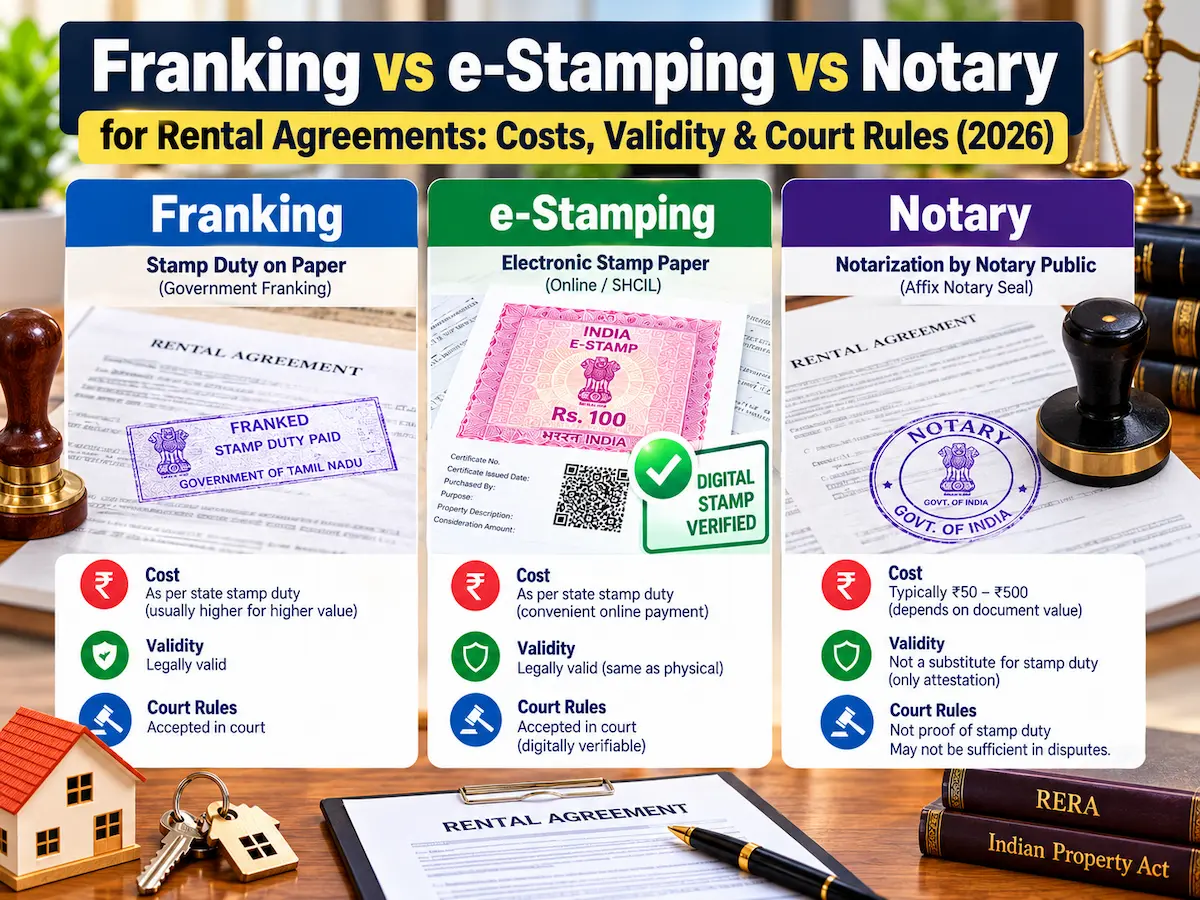
Always ensure your agreement is executed on proper e-Stamp paper. For flat ₹49, LetOutAgree provides court-approved drafts tailored to eliminate both stamping and registration risks.
This article is for informational purposes only and does not constitute legal advice. Please consult a qualified legal professional for advice specific to your situation.


Comments (0)
Login to leave a comment.