
In India, property leasing and contract law are governed by a complex dual statutory framework. While basic contractual principles arise under the central Indian Contract Act, 1872, the power to levy and collect stamp duty on tenancy instruments is an exclusive state power under Entry 63 of List II (State List) of the Seventh Schedule to the Constitution of India.
Because each state legislature enacts its own Stamp Act (or modifies the colonial Indian Stamp Act, 1899), stamp duty charges on rental agreements vary wildly across state borders. A flat ₹300 e-Stamp paper might be legally sufficient in Ahmedabad, whereas the exact same rental value in Bengaluru requires a percentage-based formula (0.5%–1% of total rent plus deposit), and in Mumbai requires a 0.25% Leave and License computation under the Maharashtra Stamp Act.
In this authoritative 2026 reference guide, we present the complete 36 State & UT Stamp Duty Rate Chart, explaining the exact formula, standard 11-month values, and official online stamping portals for every jurisdiction in India.
Table of Contents
- Constitutional Basis: Why Stamp Duty Differs by State
- Complete 36 State & UT Stamp Duty Rate Chart (2026)
- Deep Dive: Formula Calculations in Major Metros (MH, KA, DL, TN)
- Multi-Year Leases vs. 11-Month Rental Agreements
- The Danger of Understamping: Section 33 & 35 Impounding
- How to Procure the Correct e-Stamp Online in 3 Minutes
Constitutional Basis: Why Stamp Duty Differs by State
Under the Indian Constitution, rates of stamp duty in respect of bills of exchange, cheques, and promissory notes fall under the Union List (Entry 91, List I). However, rates of stamp duty in respect of documents other than those specified—including leases, leave and license agreements, conveyances, and tenancy deeds—are strictly governed by state governments under Entry 63 of List II.
Consequently, state governments utilize stamp duty on tenancies as a vital source of state revenue. Some states adopt a flat-rate structure for short-term 11-month residential agreements (e.g., Gujarat, Delhi, Haryana), while others mandate a proportional percentage formula calculated against the Average Annual Rent (AAR) and the refundable security deposit (e.g., Maharashtra, Karnataka, Uttar Pradesh).
Complete 36 State & UT Stamp Duty Rate Chart (2026)
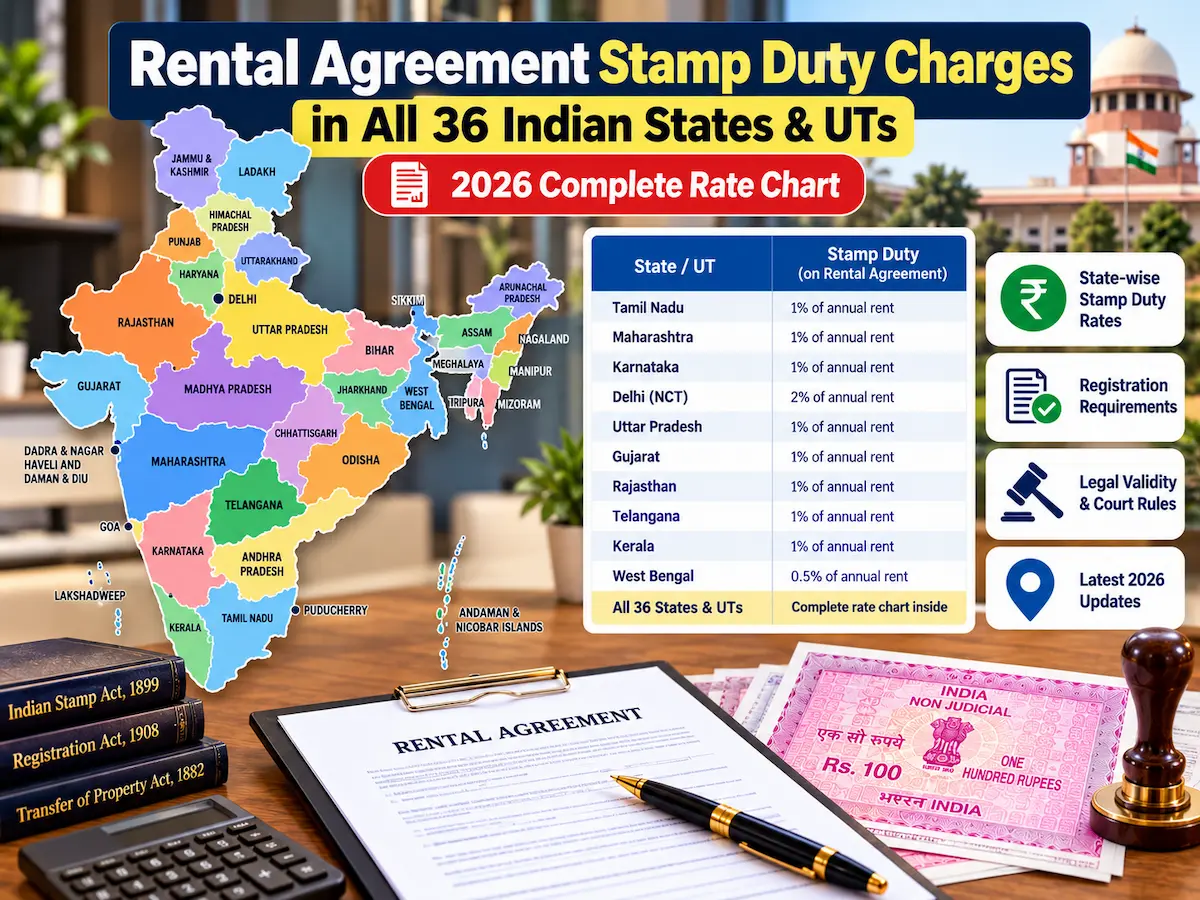
The following authoritative chart details the applicable stamp duty for 11-month residential rental agreements across all 28 states and 8 union territories:
| State / Union Territory | 11-Month Standard Stamp Paper | Long-Term Lease Formula (>11 Months) | Authorized e-Stamping Portal |
|---|---|---|---|
| Andhra Pradesh | ₹100 non-judicial e-Stamp | 0.4%–0.5% of total rent + deposit | AP IGRS / SHCIL |
| Arunachal Pradesh | ₹100 stamp paper | 1% of average annual rent | State Treasury / Non-Judicial |
| Assam | ₹100 non-judicial e-Stamp | 1%–2% of average annual rent | e-Panjeeyan Assam / SHCIL |
| Bihar | ₹1,000 (standard residential) | 1% of total rent + deposit | e-Nibandhan Bihar / SHCIL |
| Chhattisgarh | ₹100 non-judicial e-Stamp | 2% of annual rent | e-Panjeeyan CG / SHCIL |
| Goa | ₹100 to ₹500 e-Stamp | 1% of total rent + deposit | Goa Registration Portal / SHCIL |
| Gujarat | Flat ₹300 e-Stamp | 1% of average annual rent | SHCIL Gujarat |
| Haryana | ₹100 e-Stamp (e-GRAS) | 1.5% to 3% based on tenure | e-GRAS Haryana |
| Himachal Pradesh | ₹100 non-judicial e-Stamp | 2% of annual rent | HP e-Stamping / SHCIL |
| Jharkhand | ₹100 non-judicial e-Stamp | 1% of annual rent | NGDRS Jharkhand / SHCIL |
| Karnataka | 0.5%–1% of total rent + deposit (Min ₹200) | 1% to 2% of total consideration | Kaveri Online Services / SHCIL |
| Kerala | ₹200 to ₹500 e-Stamp | 1% of total rent + deposit | Kerala Registration Dept / PEARL |
| Madhya Pradesh | ₹100 to ₹500 e-Stamp | 2% of annual rent | MPIGR Sampada / SHCIL |
| Maharashtra | 0.25% of total rent + 10% non-refund deposit | 0.25% (urban/rural formula) | GRAS Maharashtra / IGR Maharashtra |
| Manipur | ₹100 stamp paper | 1% of annual rent | State Treasury / Physical Stamp |
| Meghalaya | ₹100 stamp paper | 1% of annual rent | Meghalaya Registration / Non-Judicial |
| Mizoram | ₹100 stamp paper | 1% of annual rent | State Treasury / Non-Judicial |
| Nagaland | ₹100 stamp paper | 1% of annual rent | State Treasury / Physical Stamp |
| Odisha | ₹100 non-judicial e-Stamp | 1%–2% of average annual rent | e-Registration Odisha / SHCIL |
| Punjab | ₹100 to ₹500 e-Stamp | 1.5%–2% of total rent + deposit | NGDRS Punjab / SHCIL |
| Rajasthan | ₹500 (or 0.25% of rent + deposit) | 0.25%–1% depending on duration | e-GRAS Rajasthan / SHCIL |
| Sikkim | ₹100 stamp paper | 1% of annual rent | State Treasury / Physical Stamp |
| Tamil Nadu | ₹20 to ₹100 e-Stamp (1% under TNRRRLT Act) | 1% of total rent + advance payable | TN Tenancy Portal / SHCIL TN |
| Telangana | ₹100 non-judicial e-Stamp | 0.4%–0.5% of total rent + deposit | Telangana IGRS / SHCIL |
| Tripura | ₹100 stamp paper | 1% of annual rent | State Treasury / Non-Judicial |
| Uttar Pradesh | 2% of Average Annual Rent (e-Stamping) | 2% of annual rent (Min ₹100) | IGRS UP / SHCIL UP |
| Uttarakhand | 2% of Average Annual Rent | 2% of annual rent | e-Stamping UK / SHCIL |
| West Bengal | GRIPS Slab (Typically ₹100–₹250) | 0.5%–1% based on lease tenure | GRIPS West Bengal / SHCIL |
| Delhi (UT) | 2% of AAR (or ₹100 for 11 months) | 2% of annual rent + deposit | SHCIL Delhi / DORIS Delhi |
| Chandigarh (UT) | ₹100 non-judicial e-Stamp | 1.5% of total rent + deposit | SHCIL Chandigarh |
| Jammu & Kashmir (UT) | ₹100 non-judicial e-Stamp | 1.5% of annual rent | NGDRS J&K / SHCIL |
| Ladakh (UT) | ₹100 non-judicial e-Stamp | 1.5% of annual rent | NGDRS Ladakh / SHCIL |
| Puducherry (UT) | ₹100 e-Stamp | 1% of total consideration | SHCIL Puducherry |
| Andaman & Nicobar (UT) | ₹100 stamp paper | 1% of annual rent | UT Administration / Physical Stamp |
| Dadra & Nagar Haveli and Daman & Diu | ₹100 e-Stamp | 1% of annual rent | SHCIL Daman |
| Lakshadweep (UT) | ₹100 stamp paper | 1% of annual rent | UT Revenue Department |
Deep Dive: Formula Calculations in Major Metros (MH, KA, DL, TN)
For tenants and landlords residing in high-volume metropolitan markets, understanding the exact mathematical formula is essential:
1. Maharashtra (Mumbai, Pune, Nagpur, Nashik)
Under Article 36A of the Maharashtra Stamp Act, 1958, stamp duty for Leave and License agreements is calculated as:
Stamp Duty = 0.25% × [ (Monthly Rent × Tenure in Months) + (10% × Non-Refundable Deposit) + (10% × Years of Lease × Refundable Deposit) ]
In addition, an SRO registration fee of ₹1,000 applies in municipal corporation areas (or ₹500 in rural areas).
2. Karnataka (Bengaluru, Mysuru, Mangaluru)
Under Article 30 of the Karnataka Stamp Act, 1957:
- For leases up to 11 months: Stamp duty is 0.5% of the total rent plus deposit payable, subject to a minimum of ₹200 (or typically executed on ₹200–₹500 e-Stamp paper).
- For leases exceeding 11 months up to 5 years: Stamp duty jumps to 1% of the total rent and deposit, plus compulsory registration charges.
3. Delhi NCR (New Delhi, Gurgaon, Noida)
- Delhi NCT: For residential agreements up to 11 months, a flat ₹100 non-judicial e-Stamp paper is commonly executed. For leases extending up to 5 years, the duty is 2% of the average annual rent.
- Noida (Uttar Pradesh): Under UP Stamp rules, duty is 2% of the annual rent.
- Gurgaon (Haryana): e-Stamping through e-GRAS Haryana is standard at ₹100 for 11 months.
Multi-Year Leases vs. 11-Month Rental Agreements
The vast disparity between short-term (11-month) and multi-year leases stems from Section 17 of the Registration Act, 1908:
- 11-Month Lease: Exempt from compulsory registration at the Sub-Registrar's Office. Saves substantial registration fees, eliminates physical SRO queues, and only requires state stamp duty payment.
- Multi-Year Lease (12+ Months): Compulsorily registrable. Requires higher percentage-based stamp duty (1%–3%) plus 1% SRO registration fee, biometric verification of all parties, and property deed inspection.
The Danger of Understamping: Section 33 & 35 Impounding
Executing an agreement on a ₹20 or ₹50 stamp paper when your state law mandates ₹200, ₹300, or a formula amount is called Understamping. Under Section 33 of the Indian Stamp Act, 1899:
- Any civil judge, arbitrator, or public authority is bound by law to impound an insufficiently stamped instrument immediately upon presentation.
- Under Section 35, the document cannot be read into evidence until the petitioner pays the deficit stamp duty plus a mandatory statutory penalty of 10 times the unpaid duty.
- For example, an unpaid duty of ₹500 results in an immediate ₹5,000 fine in court before your eviction or deposit recovery petition can proceed.
How to Procure the Correct e-Stamp Online in 3 Minutes
To avoid understamping penalties and confusing state calculations, use LetOutAgree. Our automated drafting platform dynamically assesses your selected state, calculates the legally required stamp duty advisory, and formats your agreement draft into an A4 print-ready PDF that seamlessly aligns with your state's e-Stamp certificate.
This article is for informational purposes only and does not constitute legal advice. Please consult a qualified legal professional for advice specific to your situation.



Comments (0)
Login to leave a comment.