
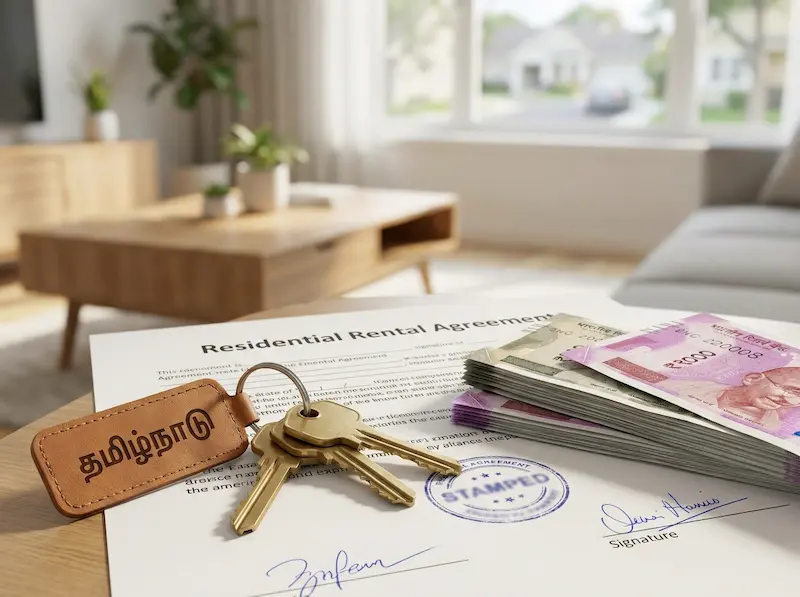
Are you renting a property in Tamil Nadu or planning to lease out your property? One of the most critical financial aspects of any rental agreement is the security deposit. How much can a landlord legally demand? What are your rights if the deposit isn't refunded? Understanding the security deposit rules under the Tamil Nadu Regulation of Rights and Responsibilities of Landlords and Tenants Act, 2017 is essential for both landlords and tenants to avoid disputes and legal complications.
In this comprehensive guide, we break down everything you need to know about security deposit limits in Tamil Nadu, refund timelines, legal deductions, and common mistakes to avoid. Whether you're a landlord seeking clarity on legal limits or a tenant wanting to protect your rights, this article has you covered.
What Is the Legal Limit for Security Deposit in Tamil Nadu?
Contrary to popular belief, there is a specific legal cap on security deposits in Tamil Nadu. Under Section 11(1) of the Tamil Nadu Regulation of Rights and Responsibilities of Landlords and Tenants Act, 2017, it is unlawful to charge a security deposit in excess of three times the monthly rent [citation:2][citation:6].
This means if your monthly rent is ₹15,000, the maximum security deposit a landlord can legally demand is ₹45,000. Any amount above this limit is illegal and cannot be enforced by law.
Important Note: The Tamil Nadu law sets the limit at 3 months' rent for residential properties. This differs from the Model Tenancy Act, 2021, which caps deposits at 2 months' rent [citation:5][citation:9]. Tamil Nadu has retained its own limit under the 2017 Act, which continues to apply in the state.
Tamil Nadu vs Model Tenancy Act: Understanding the Difference
Many people get confused between the Tamil Nadu state law and the central Model Tenancy Act (MTA), 2021. Here's the key distinction:
| Aspect | Tamil Nadu Act, 2017 | Model Tenancy Act, 2021 |
|---|---|---|
| Security Deposit Cap | 3 months' rent [citation:2] | 2 months' rent [citation:5][citation:9] |
| Status in Tamil Nadu | Currently applicable | Not officially adopted in Tamil Nadu [citation:1] |
While the central government introduced the Model Tenancy Act with a 2-month cap, Tamil Nadu has not officially adopted it. The state continues to follow its own 2017 Act, which sets the limit at 3 months' rent [citation:1]. It's worth noting that the state government has previously amended the Act in 2022 to align with certain aspects of the MTA [citation:10], but the security deposit limit remains unchanged.
Security Deposit Refund Rules in Tamil Nadu
One of the most common disputes between landlords and tenants involves the refund of the security deposit. The Tamil Nadu Act provides clear guidelines on this matter.
Timeline for Refund
Under the Act, the security deposit must be refunded to the tenant within one month (30 days) after vacation of the premises, after making due deduction of any liability of the tenant [citation:2][citation:8].
However, there's an important nuance to understand. The Act states "within one month after vacation of the premises" [citation:2]. This is different from the Model Tenancy Act which specifies refund "on the date of taking over vacant possession" [citation:9].
In 2022, the Tamil Nadu government introduced an amendment specifying that if a property becomes uninhabitable and the landlord fails to carry out repairs, the security deposit must be refunded within 15 days of the notice period expiry [citation:10].
What Can Be Deducted?
Landlords can only deduct from the security deposit for legitimate liabilities such as:
- Unpaid rent or utility bills
- Damage to the property beyond normal wear and tear
- Any other dues mentioned in the rental agreement
Landlords cannot arbitrarily withhold the deposit or use it as a penalty without justification. All deductions must be reasonable and supported by evidence.
Legal Tip: The security deposit shall be refunded to the tenant after making due deduction of any liability of the tenant. Landlords must provide a clear breakdown of any deductions made [citation:2].
Can a Landlord Demand a Higher Security Deposit?
The law is clear on this point: any security deposit exceeding three times the monthly rent is unlawful [citation:2]. However, in practice, many landlords still demand 6-10 months' rent as security deposit [citation:1].
Why does this happen? Primarily due to lack of awareness and weak enforcement. The mandatory registration of rental agreements is not strictly enforced, and many landlords and tenants operate outside the legal framework [citation:1].
What You Should Do:
- If you're a tenant, insist on a written rental agreement that specifies the security deposit amount.
- Ensure the agreement is registered with the Rent Authority.
- If a landlord demands an excessive deposit, you can cite Section 11 of the Tamil Nadu Act.
- For landlords, understanding the legal limit protects you from potential legal disputes and allegations of unfair practice.
What Happens If Your Security Deposit Isn't Refunded?
If your landlord fails to refund the security deposit within the stipulated time, you have several legal remedies available:
- Send a Legal Notice: Start by sending a formal written notice to the landlord demanding the refund.
- Approach the Rent Authority: Under the Tamil Nadu Act, you can approach the Rent Authority for dispute resolution [citation:1].
- File a Civil Suit: If the dispute isn't resolved, you can file a suit in the appropriate court for recovery of the amount.
- Important Legal Precedent: Courts have held that a tenant cannot retain possession of premises on the ground that the security deposit hasn't been refunded. The tenant has an independent remedy to recover the security but cannot withhold possession [citation:3].
It's worth noting that dispute resolution mechanisms under the Rent Authorities are not widely used due to lack of awareness and trust in the system [citation:1]. However, they remain a valid and accessible option for tenants.
Key Security Deposit Clauses Every Rental Agreement Should Have
To avoid disputes, ensure your rental agreement clearly mentions:
- The security deposit amount: Not exceeding 3 times the monthly rent.
- Refund timeline: Within 30 days of vacating the premises.
- Conditions for deduction: Clear clauses on what can be deducted.
- Interest provisions: If applicable, mention whether the deposit earns interest.
- Joint inspection clause: Include a clause for joint inspection at the time of vacating to document the property condition.
Common Mistakes to Avoid
Here are some pitfalls to watch out for:
For Landlords:
- Demanding excessive deposit: This is illegal under Section 11 of the Act.
- Delaying refund: Failure to refund within 30 days can lead to legal action.
- Not providing deduction breakdown: Always provide written justification for any deductions.
For Tenants:
- Not getting a written agreement: Oral agreements offer no protection regarding security deposit refund.
- Not documenting property condition: Take photos and videos at the time of moving in and out.
- Not following proper vacating process: Provide proper notice and formally hand over possession.
Frequently Asked Questions
Q: What is the maximum security deposit a landlord can charge in Tamil Nadu?
A: Under Section 11 of the Tamil Nadu Regulation of Rights and Responsibilities of Landlords and Tenants Act, 2017, the maximum security deposit is three times the monthly rent [citation:2].
Q: How long does a landlord have to refund the security deposit?
A: The Act requires refund within one month (30 days) after vacation of the premises, after making due deductions for any liabilities [citation:2].
Q: Has Tamil Nadu adopted the Model Tenancy Act, 2021?
A: No, Tamil Nadu has not officially adopted the Model Tenancy Act. The state continues to follow its own 2017 Act, which has a 3-month security deposit cap [citation:1].
Q: Can a landlord deduct any amount from the security deposit?
A: Landlords can only deduct for legitimate liabilities such as unpaid rent, utility bills, or damage beyond normal wear and tear. All deductions must be reasonable and justified [citation:2].
Q: What should I do if my landlord refuses to refund my security deposit?
A: You can send a legal notice, approach the Rent Authority for dispute resolution, or file a civil suit for recovery of the amount [citation:1].
Conclusion
Understanding the security deposit limits and rules under the Tamil Nadu Regulation of Rights and Responsibilities of Landlords and Tenants Act, 2017 is essential for both landlords and tenants. The law provides a clear framework: security deposits cannot exceed three times the monthly rent, and refunds must be made within 30 days of vacating the premises.
While awareness and enforcement remain challenges, knowledge is your best protection. Ensure your rental agreement is properly registered and clearly mentions all security deposit-related terms. This not only prevents disputes but also ensures you have legal recourse if issues arise.
Whether you're a landlord looking to legally structure your rental agreement or a tenant wanting to protect your deposit, staying informed about your rights and responsibilities is the first step toward a hassle-free rental experience.
Author: Muthusamy LR
Location: Chennai
Website: www.letoutagree.com
ARTICLE SOURCES
- Tamil Nadu Regulation of Rights and Responsibilities of Landlords and Tenants Act, 2017
- LawChakra - Security Deposit Rules
- Address Advisors - Security Deposit Refund
- The Hindu - Tamil Nadu Amendment, 2022
Ready to protect your rights and ensure a smooth rental experience in Tamil Nadu? Stay informed, stay compliant, and always put your rental agreement in writing with clear security deposit terms.

Comments (0)
Login to leave a comment.