
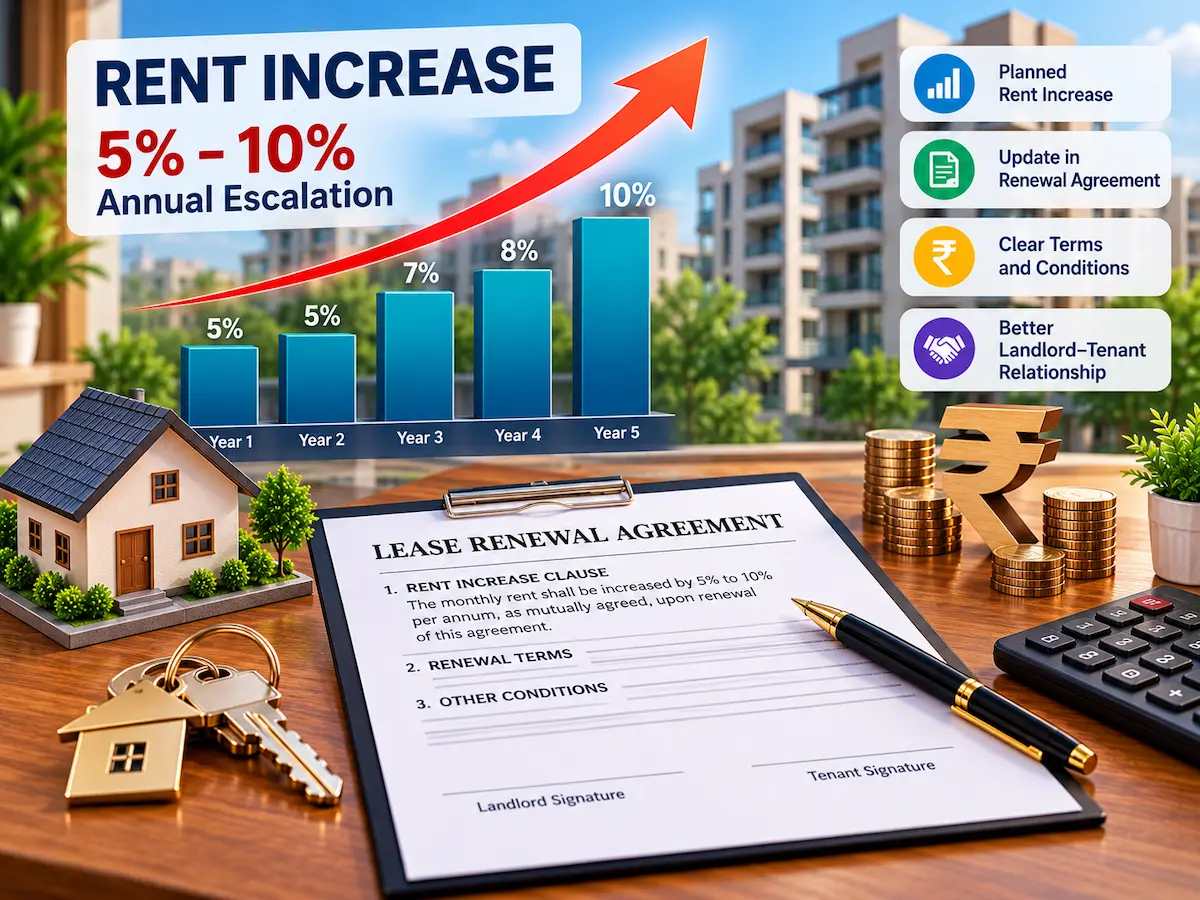
As the 11th month of a tenancy approaches, landlords and tenants across India inevitably face the same pivotal negotiation: How much will the rent increase for the coming year?
Many property owners assume that an annual 10% rent hike is an automatic government rule. Conversely, tenants in fast-growing tech hubs like Bangalore, Hyderabad, Pune, and Gurgaon are often blindsided when landlords demand 15% to 25% jumps citing booming market demand.
Does Indian law mandate a fixed percentage for annual rent escalation? Can a landlord raise the rent unexpectedly midway through a lease? What notice period is legally required, and what happens if the tenant refuses the hike?
In this comprehensive 2026 property management and legal guide, we demystify the rules governing annual rent increments in India, the provisions of the Model Tenancy Act (MTA), standard market benchmarks (5% vs. 10%), and how executing a clean lease renewal protects both parties for flat ₹49.
Renew Your 11-Month Rental Agreement in 3 Minutes
Executing a lease renewal? Lock in clear escalation terms, updated rent schedules, and statutory notice clauses on LetOutAgree for flat ₹49. Instant print-ready A4 PDF download with free screen preview.

1. Is a 10% Annual Rent Increase Mandated by Indian Law?
No, absolutely not. There is no statutory law in India—neither the Central Government, the Supreme Court, nor State Tenancy Acts—that mandates an automatic 10% annual rent increase.
Under the Indian Contract Act, 1872, tenancy in India is governed strictly by the terms of the mutual written contract signed between the landlord and tenant. If your rental agreement does not contain an express clause specifying an annual escalation percentage, the landlord has no unilateral legal right to increase the rent.
Where Did the "10% Rule" Come From?
The concept of a 10% annual hike is a long-standing market convention that evolved in Indian urban real estate during the 1990s and 2000s. It was designed to offset retail consumer price inflation (historically 5% to 7%) while providing the property owner with modest capital appreciation. Over time, brokers and court document writers standardized this 10% boilerplate into generic agreement templates, leading many to believe it was a statutory obligation.
2. Market Standards: Residential (5% to 10%) vs. Commercial (5% to 8%)
While the percentage is negotiable, standard commercial practice across Indian metropolitan areas follows these benchmarks:
- Residential Properties: Standard escalation ranges between 5% and 10% per annum upon completion of an 11-month or 12-month tenure. In mature residential areas, 5% to 8% is common; in high-demand IT corridors (e.g., Whitefield in Bangalore, Hitec City in Hyderabad, or Hinjewadi in Pune), owners frequently request 10%.
- Commercial Real Estate (Shops & Offices): Commercial leases are typically longer (3, 5, or 9 years). The standard escalation is either 5% annually or 15% compounded every 3 years.
Comparison: Impact of Escalation Slabs Over 3 Years
To understand how compounding affects your household budget, consider an initial rent of ₹25,000 per month:
| Tenure Year | At 5% Annual Hike | At 7.5% Annual Hike | At 10% Annual Hike |
|---|---|---|---|
| Year 1 (Initial Rent) | ₹25,000 / month | ₹25,000 / month | ₹25,000 / month |
| Year 2 (First Renewal) | ₹26,250 (+₹1,250) | ₹26,875 (+₹1,875) | ₹27,500 (+₹2,500) |
| Year 3 (Second Renewal) | ₹27,562 (+₹2,562) | ₹28,890 (+₹3,890) | ₹30,250 (+₹5,250) |
3. Notice Period Rules Under the Model Tenancy Act (MTA)
A critical protection introduced under the Model Tenancy Act (MTA) addresses unfair, surprise rent increases:
- Mandatory 3 Months' Prior Written Notice: Under Section 9(2) of the Model Tenancy Act, if a landlord intends to revise the rent, they must issue a formal written notice to the tenant at least 3 months prior to the date on which the increased rent becomes payable.
- Tenant's Right to Terminate: If the tenant does not agree to the revised rent proposed in the notice, they have the right to serve a termination notice and vacate before the expiry of the 3-month window without penal deduction.
- Deemed Acceptance: If the tenant receives the 3-month notice and continues to occupy the premises without written objection, the law deems the revised rent accepted.
Mid-Term Rent Increases Are Illegal: A landlord cannot demand an increase in rent during the active tenure of an agreed 11-month contract. The agreed rent is legally frozen until the agreement term expires.
Draft Your Updated Lease Renewal Agreement
Create a legally valid rental agreement online with instant print-ready download.
Draft Agreement Now (₹49)
4. What If the Tenant Refuses the Proposed Rent Increase?
When parties reach an impasse at lease expiry, Indian law outlines a clear framework:
- Negotiation Based on Market Comparables: The most constructive approach is reviewing real estate portals (99acres, MagicBricks) to identify identical flats in the same apartment society. If comparable units rent for ₹27,000, a landlord cannot reasonably demand ₹32,000.
- Mutual Non-Renewal: If agreement cannot be reached, the tenancy naturally terminates upon completion of the 11th month. The tenant provides standard 1-month notice, hands over keys, and receives their full security deposit refund under the security deposit refund rules.
- Unlawful Self-Help Actions Are Prohibited: A landlord frustrated by a tenant's refusal to accept a rent hike cannot disconnect electricity, shut off water supply, or lock the tenant out. Doing so is an offense punishable under Section 441 of the Indian Penal Code (criminal trespass) and state tenancy enactments.
5. Capital Improvements vs. Routine Maintenance
Can a landlord increase rent by more than 10% if they upgrade the property? Yes.
Under Section 10 of the Model Tenancy Act, if the landlord carries out structural improvements, additions, or major capital enhancements (e.g., retrofitting complete modular kitchens, installing high-capacity air conditioning, or waterproofing and modernizing bathrooms) with the tenant's written consent, the rent can be revised upward prior to the standard renewal period by mutual written agreement.
However, routine repairs (fixing leaking taps, servicing pre-existing geysers, or exterior society repainting) are landlord maintenance responsibilities and do not justify a rent increase.
6. The Perils of an "Informal" Renewal Without a Written Agreement
Many tenants and landlords fall into a dangerous trap upon lease expiry: the landlord asks for ₹2,000 more, the tenant starts paying via UPI, but neither party executes a fresh written contract.
Operating on an expired agreement creates immense legal vulnerabilities:
- Conversion to Month-to-Month Tenancy: Under Section 106 of the Transfer of Property Act, 1882, tenancy without a written fixed-term contract automatically converts into a month-to-month tenancy terminable by either party with just 15 days' notice.
- HRA Tax Exemption Disallowance: As detailed in our guide on HRA exemption and rent agreements, employers and tax auditors will disallow HRA deductions if your submitted agreement shows an expired tenure or a rent figure that doesn't match your bank transfers.
- Security Deposit Vulnerability: Without an active, signed contract specifying move-out inspection timelines, tenants face prolonged delays when recovering deposits.
7. How LetOutAgree Simplifies Lease Renewals in 3 Minutes
Renewing your rental agreement every 11 months should not involve paying ₹1,000 to ₹2,000 to third-party brokers or standing in court queues.
With LetOutAgree, executing a fresh, state-compliant 11-month agreement takes just 3 minutes:
- Enter Updated Terms: Input the revised monthly rent, security deposit balance, and customized annual escalation clauses in our intuitive online form.
- Free Live Preview: Read the full legal text on your screen to verify names, dates, and clauses.
- Download Instant PDF (₹49): Pay a flat ₹49 to download your formatted, high-resolution A4 document. Attach it to your state's e-Stamp certificate, sign with two witnesses, and enjoy complete legal peace of mind!
Explore our companion guides for further tenancy and legal insights: Why Rental Agreements Are 11 Months, 15 Crucial Rental Agreement Clauses Checklist, and Security Deposit Dispute Recovery Guide.
This article is for informational purposes only and does not constitute legal advice. Please consult a qualified legal professional for advice specific to your situation.



Comments (0)
Login to leave a comment.