
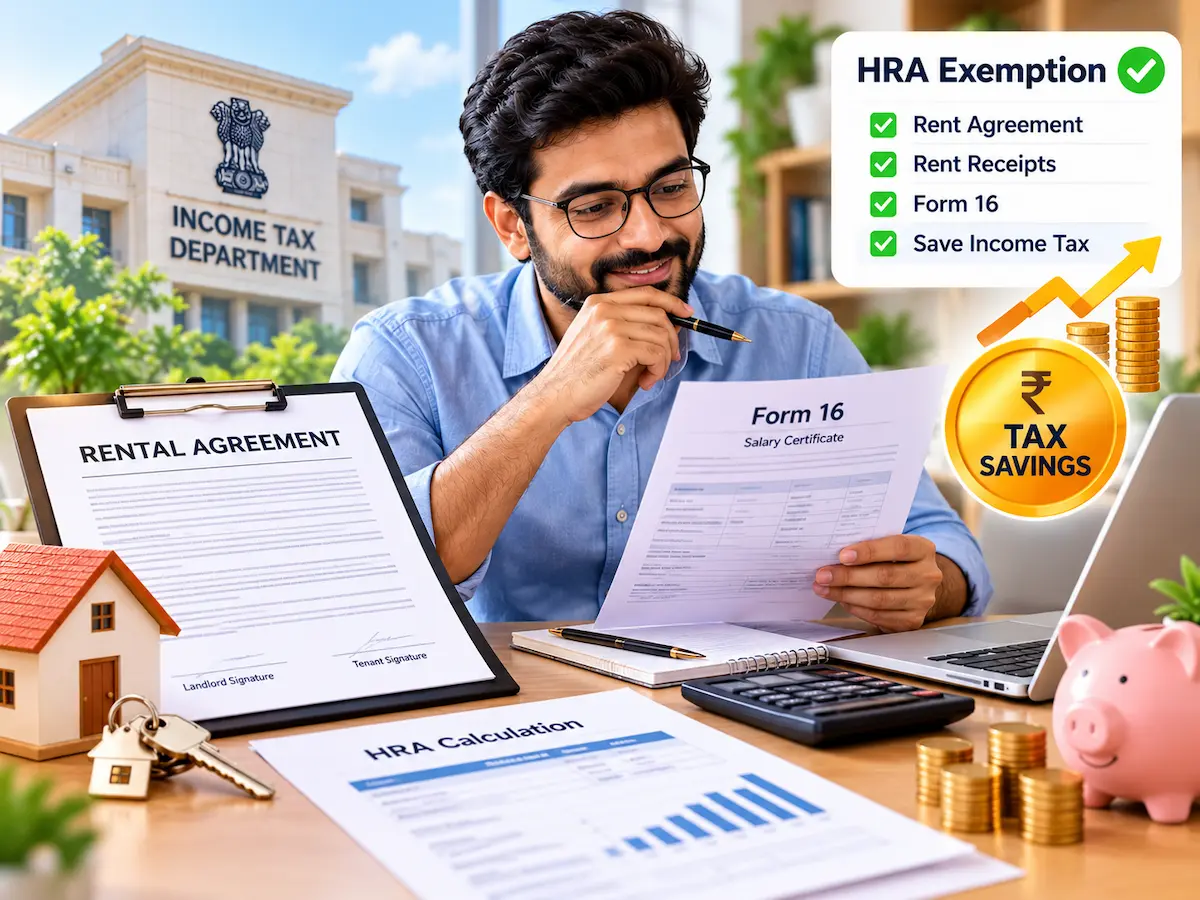
Every financial year between December and February, millions of salaried employees across India encounter the same urgent corporate HR circular: "Submit your investment proofs and House Rent Allowance (HRA) documentation by the deadline to prevent heavy TDS deduction from your salary."
Immediately, employees rush to gather their rent receipts. But then comes the crucial question that confuses both first-time renters and seasoned corporate professionals: Is a formal rental agreement strictly mandatory to claim HRA tax exemption, or are signed rent receipts enough?
Furthermore, what happens if your annual rent crosses ₹1,00,000? What if your landlord refuses to share their PAN card? And can you legally pay rent to your parents to claim HRA under current Income Tax Department rules?
In this definitive 2026 tax and legal guide, we demystify the statutory requirements under Section 10(13A) of the Income Tax Act, 1961, CBDT circulars, Income Tax Appellate Tribunal (ITAT) rulings, and how you can obtain an employer-compliant agreement in minutes.
Need an Instant Rent Agreement for HRA Proof?
Generate a legally compliant, attorney-formatted rental agreement tailored for employer tax submission (Form 12BB). Includes landlord PAN clause, rent receipt schedules, and instant print-ready A4 PDF download for flat ₹49.

1. The Legal Framework: Section 10(13A) and Rule 2A
House Rent Allowance (HRA) is an integral component of most Indian salary packages. Under Section 10(13A) of the Income Tax Act, 1961, read in conjunction with Rule 2A of the Income Tax Rules, 1962, salaried individuals residing in rented accommodations are entitled to claim tax exemption on their HRA.
The exempt amount is calculated as the lowest of the following three figures:
- Actual HRA received from your employer.
- Actual rent paid minus 10% of your basic salary (plus Dearness Allowance, if applicable).
- 50% of basic salary (for metro cities: Delhi, Mumbai, Kolkata, Chennai) or 40% of basic salary (for non-metro cities like Bangalore, Hyderabad, Pune, etc.).
Note: HRA tax exemption is available only if you choose to file your taxes under the Old Tax Regime. Under the New Tax Regime (Section 115BAC), HRA exemption cannot be claimed.
2. Is a Rental Agreement Strictly Mandatory by Law?
To understand whether a rental agreement is mandatory, we must distinguish between statutory tax law and employer verification procedures:
A. What the Income Tax Act Says
Technically, Section 10(13A) states that an exemption is granted on proof of "actual expenditure incurred on payment of rent". The statute itself does not explicitly utter the phrase "registered lease deed". Historically, CBDT circulars stipulated that rent receipts signed by the landlord were primary evidence of rent payment.
B. Why Employers Compulsorily Demand a Rental Agreement
Under Section 192 of the Income Tax Act, employers are legally obligated to deduct Tax at Source (TDS) accurately from employee salaries. If an employer allows an unwarranted HRA deduction based on fabricated rent receipts, the employer is treated as an "assessee-in-default" and faces penal interest under Section 201.
To insulate themselves from tax liability, virtually all major Indian companies, MNCs, and HR portals (including Workday, GreytHR, Darwinbox, ZingHR, and Keka) have established strict internal compliance policies:
- Rent up to ₹3,000 per month: Rent receipts are usually sufficient; agreement is optional.
- Rent between ₹3,001 and ₹8,333 per month: Rent receipts AND a formal signed rental agreement are mandatory.
- Rent exceeding ₹8,333 per month (₹1,00,000 annually): Rent receipts, signed rental agreement, AND Landlord's PAN card are strictly compulsory under statutory CBDT rules.
The Bottom Line: While a tax officer during scrutiny might theoretically accept secondary payment proofs, your employer will reject your HRA claim on Form 12BB if you do not attach a valid rental agreement. Without it, your employer will deduct heavy TDS in your January, February, and March payslips.
3. The ₹1,00,000 Annual Rent Threshold & Landlord PAN Rules
In 2013, the Central Board of Direct Taxes (CBDT) issued Circular No. 08/2013, which revolutionized HRA verification. Under this mandate:
"Where the annual rent paid by the employee exceeds ₹1,00,000 per annum (approx. ₹8,334 per month), it is mandatory for the employee to report the Permanent Account Number (PAN) of the landlord to the employer."
What If the Landlord Does Not Have a PAN?
If your landlord does not possess a PAN (for instance, an elderly pensioner whose income falls below the taxable threshold), the law requires the landlord to provide a written declaration along with Form 60 (under Rule 114B of Income Tax Rules), certifying that they do not hold a PAN, along with their full name, address, and signature.
The Danger of Submitting a "Fake" Landlord PAN
In previous years, some employees resorted to entering random or fictitious PAN numbers to claim HRA. Today, doing so is catastrophic:
- The Income Tax Department's Annual Information Statement (AIS) and Taxpayer Information Summary (TIS) automatically cross-reference HRA claims against the PAN of the property owner.
- If you quote a PAN, that rent amount is reflected in the landlord's AIS as "Rental Income". If the landlord has not declared it, or if the PAN belongs to an unsuspecting stranger, automated notices under Section 133(6) or Section 148A are triggered for both parties.
- Under Section 270A, penalties for under-reporting or misreporting of income can be as high as 200% of the tax evaded.
4. Summary Matrix: Documentation Required by Rent Slabs
| Annual Rent Range | Monthly Rent | Rent Agreement Required? | Landlord PAN Required? |
|---|---|---|---|
| Up to ₹36,000 | Up to ₹3,000 | Optional (Receipts suffice) | No |
| ₹36,001 to ₹1,00,000 | ₹3,001 to ₹8,333 | Mandatory by most employers | No |
| Above ₹1,00,000 | Above ₹8,333 | Strictly Compulsory | Strictly Compulsory (or Form 60) |
| Above ₹6,00,000 | Above ₹50,000 | Strictly Compulsory | Compulsory + 2% TDS under Sec 194-IB |
Generate an Employer-Ready HRA Rental Agreement in 3 Minutes
Create a legally valid rental agreement online with instant print-ready download.
Draft Agreement Now (₹49)
5. Paying Rent to Parents: Can You Claim HRA Legally?
One of the most popular tax planning strategies among young professionals living in their family home is paying rent to their parents and claiming HRA exemption. This is 100% legal, provided it is executed with genuine commercial documentation.
In multiple landmark rulings (such as the ITAT Ahmedabad judgment in Bajrang Prasad Ramdharani v. ACIT), tax tribunals have upheld the right of an assessee to pay rent to their parents. However, the tax authorities will disallow the claim as a sham transaction unless the following 5 golden rules are followed:
- Parent Must Be the Legal Owner: The residential property must be registered in your parent's name (solely or jointly). You cannot claim HRA if you are a co-owner of the property.
- Execute a Written Rental Agreement: Verbal arrangements do not stand up to tax scrutiny. You must execute a formal, written rental agreement specifying the monthly rent, property address, and tenancy terms on proper stamp paper.
- Transparent Banking Trail: Rent must be paid via electronic banking channels (UPI, NEFT, IMPS, or bank transfer). Cash payments without bank withdrawals will be treated with extreme suspicion.
- Parent Must Declare Rental Income: Your parent must file their Income Tax Return (ITR) and declare the rent received under the head "Income from House Property". They can claim the standard 30% statutory deduction under Section 24(a), reducing their net tax liability.
- Paying Rent to Spouse is NOT Allowed: Unlike parents, the Income Tax Department and various High Courts have consistently held that a husband and wife cannot enter into a commercial landlord-tenant contract while living together under matrimonial obligations.
6. Does the Agreement Need to Be Registered or Notarized for HRA?
For HRA exemption purposes, an 11-month rental agreement executed on non-judicial stamp paper and attested by a Notary Public is 100% accepted by employers and the Income Tax Department.
As explained in our legal breakdown of why rental agreements are signed for 11 months in India, contracts under 12 months are exempt from compulsory Sub-Registrar registration under Section 17 of the Registration Act, 1908 (with the exception of Maharashtra, where registration is mandatory).
Your employer simply requires a clear, scanned PDF showing:
- Full legal names of tenant and landlord.
- Complete address of the rented premises matching your city of employment.
- Commencement date and monthly rent amount.
- Signatures of both parties on state-prescribed stamp paper.
- Landlord's PAN (if rent exceeds ₹8,333/month).
7. Can You Claim Both HRA and Home Loan Tax Deductions?
Yes, absolutely. Many taxpayers believe that owning a home disqualifies them from claiming HRA. That is a misconception. You can simultaneously claim both benefits under the following legitimate conditions:
- Different City Due to Employment: You own a home in your hometown (claiming Section 24 interest deduction up to ₹2 Lakh and Section 80C principal repayment up to ₹1.5 Lakh), but you live in a rented apartment in Bangalore, Delhi NCR, Pune, or Hyderabad because of your job.
- Under-Construction Property: Your own property is still under construction by a developer, forcing you to live in rented premises.
- Home Given on Rent: You own a house in the same city, but it is located far from your workplace and let out to another tenant (you declare that rental income and claim HRA on the house you rent closer to office).
8. Common Mistakes That Lead to HRA Rejection or Tax Notices
Avoid these frequent pitfalls during proof submission:
- Mismatch Between Payslip HRA and Actual Rent: Your exemption depends on actual rent paid, not just the HRA allowance in your CTC. Ensure your agreement figures match your rent payments.
- Lapse in Agreement Tenure: If your 11-month agreement expired in October, you must renew it immediately for the remaining months of the financial year. Employers will prorate and disallow HRA for unrepresented months.
- Shared Flat Inconsistencies: If you share a flat with roommates, ensure the agreement lists all co-tenants or states your specific share of rent; otherwise, the entire rent cannot be claimed by one individual.
- Not Collecting Rent Receipts: Along with the agreement, maintain signed monthly rent receipts bearing a ₹1 revenue stamp for cash payments exceeding ₹5,000, or banking payment screenshots.
9. How to Generate an Employer-Compliant HRA Agreement on LetOutAgree
If your company's HR deadline is looming and you need a legally airtight agreement today, do not waste time chasing stamp vendors or paying ₹500 to ₹1,000 to third-party brokers.
With LetOutAgree, creating a compliant agreement takes just 3 minutes:
- Fill Details Online: Enter landlord, tenant, address, rent amount, and landlord PAN in our streamlined digital form.
- Review Free Live Preview: Verify all clauses, names, and rent schedules right on your screen.
- Instant PDF Download (₹49): Pay a flat ₹49 to download your formatted, high-resolution A4 PDF. Print directly, affix on stamp paper, sign, and upload to your corporate HR portal!
Explore our companion guides for further guidance on drafting and compliance: 15 Crucial Rental Agreement Clauses Checklist, Bangalore Rental Agreement Guide, Delhi NCR Tenancy Rules, and Maharashtra Rental Registration Guidelines.
This article is for informational purposes only and does not constitute legal advice. Please consult a qualified legal professional for advice specific to your situation.



Comments (0)
Login to leave a comment.