

In India's bustling employment and educational hubs—such as Bengaluru, Gurugram, Pune, Mumbai, Hyderabad, Noida, and Chennai—skyrocketing residential rents and massive security deposit demands have made flat-sharing the economic default for young software engineers, corporate professionals, and university students. Splitting a spacious 3BHK flat in Koramangala, Hitec City, or Cyber City among three roommates allows individuals to enjoy premium gated-community amenities at a fraction of the cost of renting an independent flat.
However, co-living without a clear, documented legal framework is one of the most volatile living arrangements in urban India. Sincere friendships frequently disintegrate over messy financial disagreements: a flatmate suddenly resigns from their job and absconds overnight without paying their share of the rent, another flatmate refuses to pay their portion of the electricity bill, or an outgoing roommate demands their full security deposit back while the landlord refuses to refund a single rupee until the entire 11-month lease concludes.
The core legal trap lies in the doctrine of "Joint and Several Liability" governed by Section 43 of the Indian Contract Act, 1872. When multiple tenants sign a standard rental agreement, the landlord has the legal right to demand the full contractual rent from any one of the occupants, leaving conscientious roommates legally on the hook for a defaulting flatmate's dues!
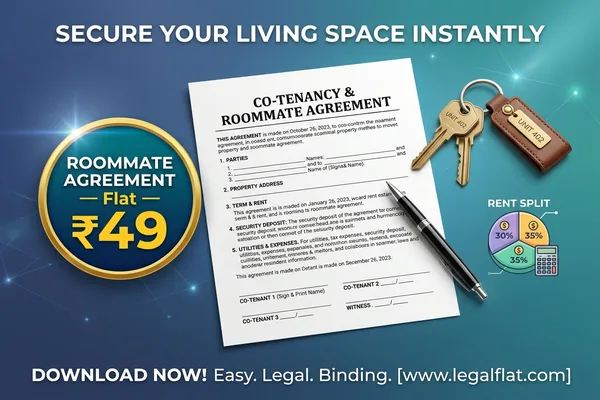
To protect your wallet, domestic peace, and legal rights, flatmates must adopt a professional, dual-layered legal strategy: executing a multi-tenant co-tenancy lease with the property owner and executing an internal Roommate Agreement (Flatmate Code of Conduct). In this comprehensive 2026 guide, we explain how to structure shared leases, split rent and deposits fairly, manage sudden move-outs, and draft an airtight co-living agreement on LetOutAgree for flat ₹49.
Draft a Multi-Tenant Co-Living Agreement on LetOutAgree
Avoid roommate rent disputes. Draft an attorney-vetted agreement that includes all flatmates as joint licensees, outlines individual deposit contributions, and establishes clear replacement protocols for flat ₹49.
The Legal Core: Understanding Joint & Several Liability in Shared Flats
Before moving in with friends or flatmates found on social media groups, you must understand how Indian courts interpret multi-party rental contracts under the Indian Contract Act, 1872 and the Transfer of Property Act, 1882:
- Joint and Several Liability (Section 43 Contract Act): In a standard joint tenancy, every co-tenant is individually and collectively responsible for 100% of the contractual obligations. For example, if three flatmates sign a lease for ₹45,000 per month (agreeing verbally to pay ₹15,000 each) and Roommate A loses their job and defaults, the landlord is legally entitled to recover the unpaid ₹15,000 directly from Roommate B or Roommate C. The landlord is not bound by your informal internal split!
- The "Lead Tenant" Fallacy: Many roommate groups make the fatal mistake of letting only one person (the "lead tenant") sign the agreement to save paperwork. If you are the sole signatory, you bear 100% legal, civil, and criminal liability for the entire flat. If your flatmates damage the property or default, the landlord will sue you exclusively, and you cannot claim contribution without an internal written contract.
Why Every Flatmate's Name Must Be on the Primary Rental Agreement
Insist that the property owner includes every residing flatmate as an individual co-licensee on the formal 11-month agreement:
- Tax Benefit Rights (HRA Exemption under Section 10(13A)): Salaried IT employees can claim House Rent Allowance (HRA) tax deductions from their employers only if their name is explicitly printed on the legal agreement and their bank transfer records match their share of the rent. If your name is absent, your HR and the Income Tax Department can disallow your HRA claim. Read our guide on HRA Exemption & Rental Agreement Rules.
- Statutory Police Verification & Society Entry: Under executive orders under Section 188 IPC / Section 223 BNS, all occupants must be verified. Resident Welfare Associations (RWAs) in gated societies will deny gate entry, parking stickers, or clubhouse access to unlisted occupants.
- Protection Against Unlawful Lockouts: If your name is on the registered agreement, the landlord or a rogue roommate cannot change the door locks or claim you are an illegal trespasser.
The Internal Roommate Agreement: The Golden Shield for Flatmates
While the primary lease with the landlord establishes tenancy, an internal Roommate Agreement (Flatmate Code of Conduct) is a legally binding contract between the co-tenants themselves. This document governs day-to-day household operations and prevents financial exploitation:
1. Room Allocation & Differential Rent Calculation
Not all bedrooms in a 3BHK are equal. The master bedroom often features an attached bathroom, walk-in closet, and balcony, while the third bedroom may be smaller with a common hallway bathroom. Instead of a naive equal split, structure rent based on amenities:
- Master Bedroom (Attached Bath & Balcony): 40% of total rent (e.g., ₹24,000 of ₹60,000 total)
- Second Bedroom (Attached Bath): 32% of total rent (e.g., ₹19,200)
- Third Bedroom (Common Bath): 28% of total rent (e.g., ₹16,800)
2. Shared Utility & Domestic Expense Formula
Document the exact division of shared recurring costs:
- Electricity and piped cooking gas (PNG/LPG cylinders)
- High-speed fiber Wi-Fi internet broadband connection
- Cook and maid salaries, daily newspaper, and RO water can subscriptions
- Common household groceries (cleaning supplies, cooking oil, spices, detergent)
- Agreement to settle all shared expenses via digital expense apps (Splitwise / UPI) by the 5th of each month.
3. The 30-Day Move-Out Notice & Replacement Tenant Protocol
What happens if a roommate receives a job transfer, gets married, or decides to move out mid-lease? The roommate agreement must establish a strict protocol:
- Mandatory Advance Notice: An outgoing flatmate must provide at least 30 to 45 days' written advance notice to the remaining roommates.
- Duty to Find a Replacement: The outgoing flatmate carries the primary responsibility of finding a replacement flatmate who is mutually acceptable to the remaining roommates and the landlord.
- Rent Continuation Liability: If the outgoing roommate fails to find an approved replacement, they remain legally obligated to pay their monthly rent share until the notice period concludes or a replacement moves in.
4. Security Deposit Settlement Without Involving the Landlord
Landlords will not refund 1/3rd of a security deposit mid-lease. The clean, established urban protocol is:
- The remaining flatmates inspect the outgoing roommate's bedroom for physical damages.
- Any unpaid utility bills or repair costs are deducted from the outgoing roommate's original deposit share.
- The incoming replacement flatmate pays their security deposit directly to the outgoing flatmate upon move-in, keeping the landlord's master security deposit intact!
5. House Rules, Overnight Guests & Quiet Hours
Lifestyle friction causes more roommate breakups than finances. Document clear boundaries:
- Overnight Guests: Permitted with prior notice, but continuous stays exceeding 3 to 5 days require unanimous roommate approval. A partner cannot "unofficially move in" without contributing to rent and utilities!
- Quiet Hours: Mandatory quiet hours between 11:00 PM and 7:00 AM on weekdays to respect working schedules.
- Smoking & Alcohol Policies: Clear rules regarding designated smoking zones (balcony only) and cleanliness after weekend social gatherings.
Comparison: Single-Tenant Lease vs. Co-Tenancy with Roommate Agreement
Draft Your Co-Living Agreement on LetOutAgree
Whether you are moving into a shared flat in Whitefield Bengaluru, Hinjewadi Pune, Cyber City Gurugram, or OMR Chennai, never rely on casual handshakes. LetOutAgree makes drafting a multi-tenant co-living agreement effortless for flat ₹49:
- Select Agreement Type: Choose Residential Rental Agreement on LetOutAgree.
- Input Multiple Co-Tenants: Add all roommate names, individual Aadhaar/Passport numbers, and PAN cards directly into the contract schedules.
- Pre-Structured Shared Covenants: Our intelligent legal engine incorporates balanced joint liability clauses, replacement tenant terms, and individual rent apportionment.
- Instant Free Live Preview: Verify all names, individual deposit amounts, and flat rules on your screen before payment.
- Flat ₹49 Instant PDF Download: Receive your high-resolution A4 agreement ready for state e-Stamping in under 3 minutes.
This article is for informational purposes only and does not constitute legal advice. Please consult a qualified legal professional for advice specific to your situation.



Comments (0)
Login to leave a comment.