

If you have ever rented a flat, independent house, or commercial space anywhere in India, you have almost certainly encountered an agreement drafted for exactly 11 months.
Why not a clean 12 months (1 full year) or 2 years? Is the 11-month duration just a random real estate tradition, a legal loophole, or a statutory strategy?
Many tenants and property owners mistakenly believe that an 11-month agreement is an "informal" shortcut that has no legal standing in a court of law. This is completely untrue. The 11-month tenure is a calculated, legally backed practice grounded in the Registration Act, 1908 and Indian contract law.
In this comprehensive legal guide, we break down the exact statutory provisions behind the 11-month rule, its evidentiary validity in Indian courts, the significant stamp duty savings it provides, and the crucial state exception you must know if you live in Maharashtra.
Create a Legally Enforceable 11-Month Agreement
Skip document writers and long notary lines. Create an attorney-formatted, state-compliant 11-month rental agreement on LetOutAgree for flat ₹49. Includes live screen preview, custom legal clauses, and instant print-ready A4 PDF.

1. The Legal Foundation: Section 17 of the Registration Act, 1908
The entire practice of executing 11-month agreements stems from a single, critical statutory provision: Section 17(1)(d) of the Registration Act, 1908.
The statute explicitly mandates that:
"Leases of immovable property from year to year, or for any term exceeding one year, or reserving a yearly rent, shall be compulsorily registered."
Pay close attention to the words: "for any term exceeding one year" (which legally equates to 12 months or more).
By fixing the lease period at 11 months (or 11 months and 29 days), the agreement legally remains under the 12-month statutory threshold. Consequently, compulsory registration at the Sub-Registrar Office (SRO) is completely waived in most Indian states.
2. Massive Financial & Procedural Savings
Compulsory registration of a property lease is neither simple nor cheap. It requires both landlord and tenant to:
- Book an appointment and physically visit the local Sub-Registrar Office (or complete complex biometric verification).
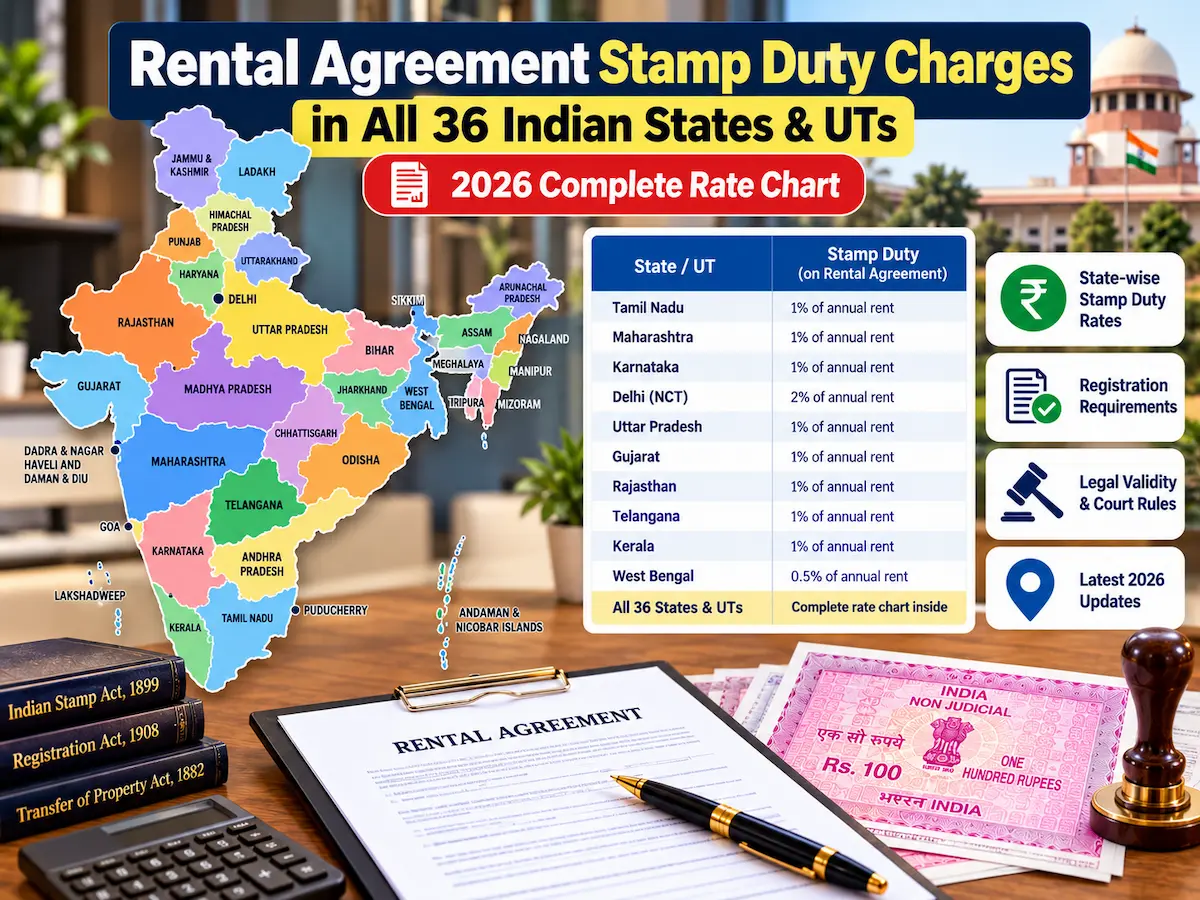
- Pay substantial Stamp Duty, which in states like Delhi, Uttar Pradesh, and Karnataka can range from 1% to 2% of the average annual rent plus security deposit.
- Pay separate government Registration Charges (often ₹500 to ₹1,100+) plus document processing and advocate drafting fees (₹3,000 to ₹7,000).
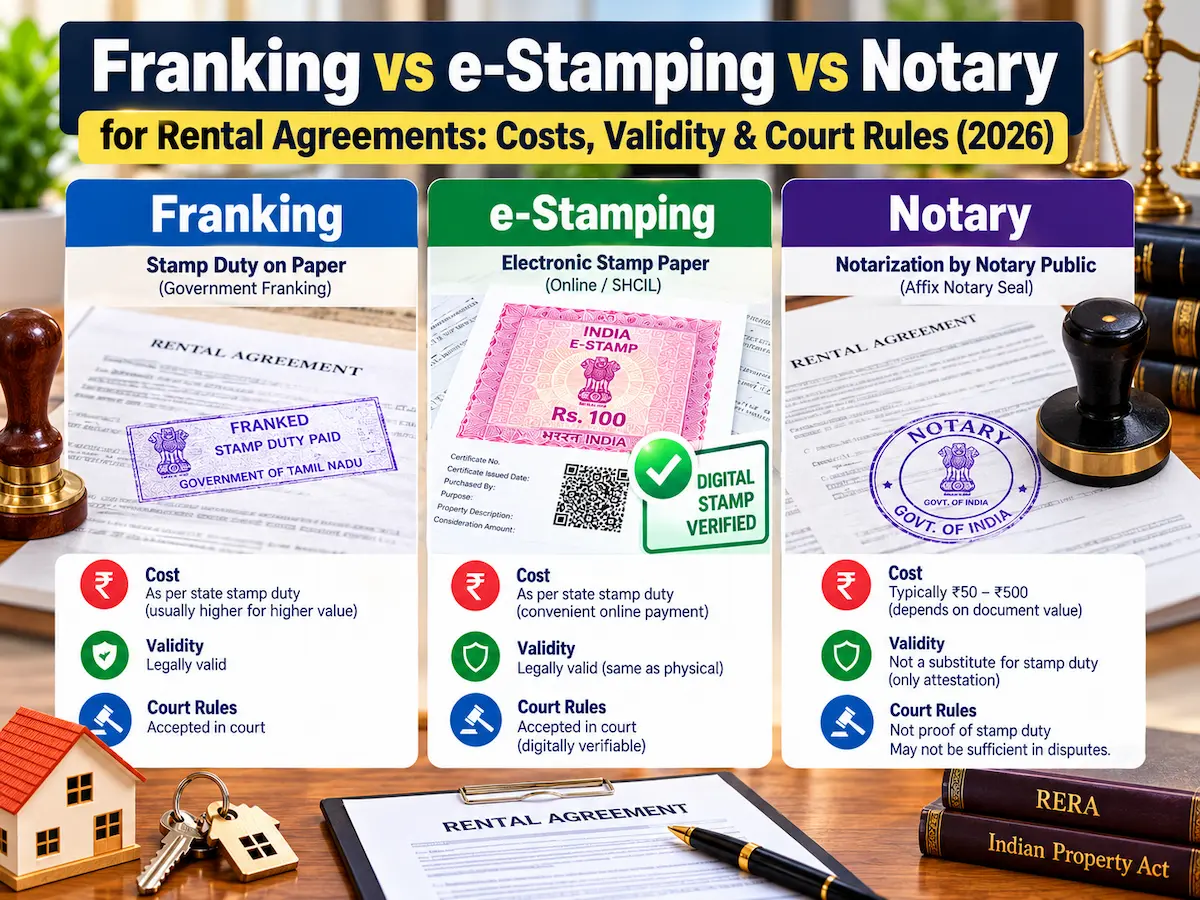
By choosing an 11-month tenure, the parties only need to execute the agreement on the state-prescribed non-judicial stamp paper (typically ₹20 in Tamil Nadu, ₹100 in Delhi/Karnataka/UP, ₹300 in Gujarat, or ₹500 in MP) and get it notarized by an authorized Notary Public. Total cost: under ₹200 to ₹600, taking minutes instead of days.
3. Comparison: 11-Month Agreement vs. 12+ Month Registered Lease Deed
| Feature | 11-Month Notarized Agreement | 12+ Month Registered Lease |
|---|---|---|
| Governing Law | Indian Contract Act, 1872 & State Stamp Acts | Registration Act, 1908 & Transfer of Property Act |
| SRO Registration | Exempt / Optional (Except Maharashtra) | Strictly Compulsory under Section 17 |
| Stamp Duty Cost | Fixed nominal stamp paper (₹20 – ₹500) | 1% to 3% of total rent + deposit value |
| Turnaround Time | Instant (3 minutes online on LetOutAgree) | 3 to 10 days for registry slot booking & biometric approval |
| Admissibility in Court | Fully Admissible as primary contract evidence | Fully Admissible (Absolute public record) |
4. Is an 11-Month Agreement Legally Valid in Court?
Yes, 100%. A widespread myth suggests that because an 11-month agreement is not registered with the government, it is invalid in court. This is a misunderstanding of Indian evidence law.
Here is what the legal jurisprudence actually dictates:
- The Indian Contract Act, 1872: An agreement executed between two competent parties, with lawful consideration (rent) and lawful object, signed in writing and supported by proper stamp duty, is a legally enforceable contract.
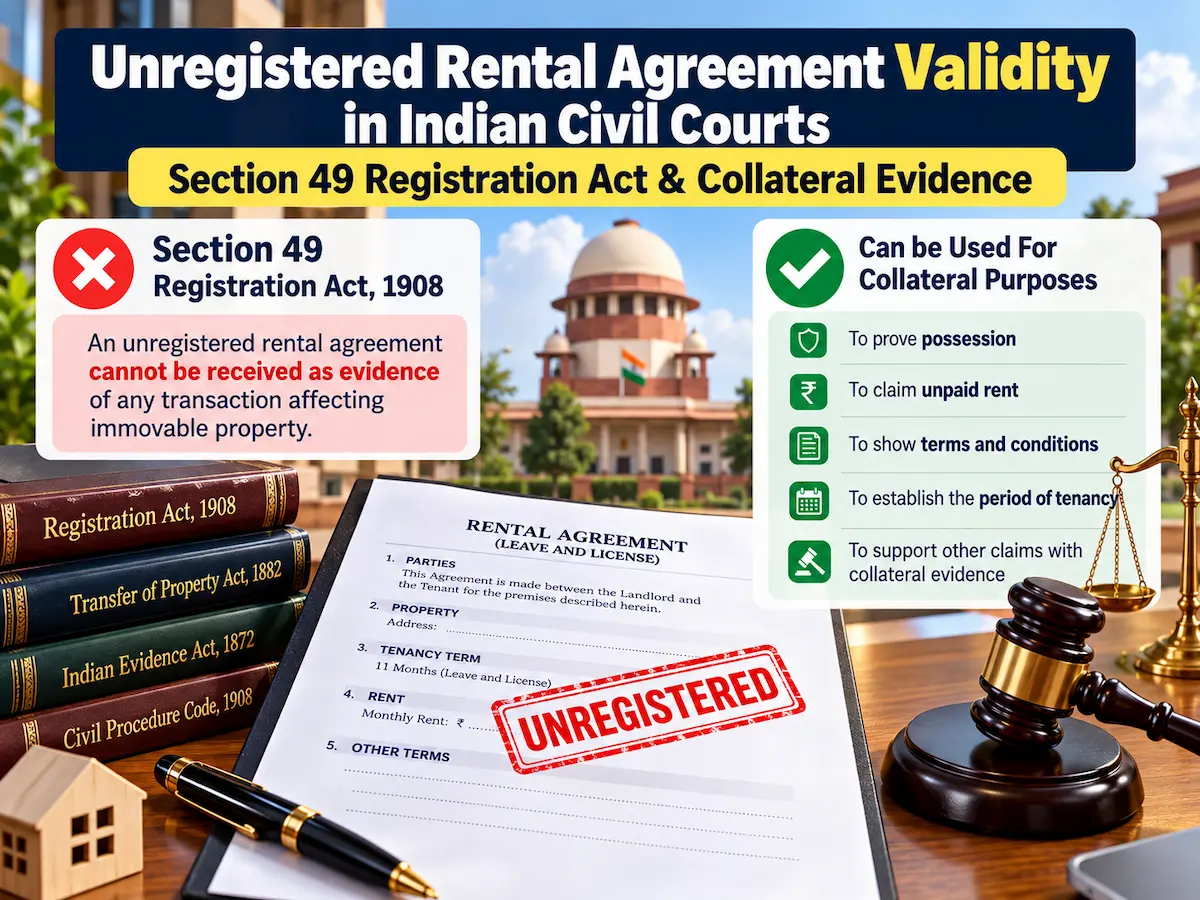
- Section 49 of the Registration Act, 1908: This section states that a document that is compulsorily registrable under Section 17 cannot be received as evidence of any transaction affecting immovable property if it is not registered. Crucially, because an 11-month agreement is NOT compulsorily registrable under Section 17, Section 49's penalty bar does NOT apply to it!
- Judicial Precedents: High Courts across India and the Supreme Court have repeatedly held that an unregistered 11-month tenancy agreement, when properly stamped, is fully admissible in evidence to prove the terms of tenancy, agreed monthly rent, lock-in period, and eviction upon expiry.
The Dangerous Flip Side: If you sign an agreement for 12 months or longer and fail to register it at the Sub-Registrar Office, it becomes legally defective. Under Section 49, courts will refuse to admit it as primary evidence to enforce your lease clauses!
Draft Your Court-Compliant 11-Month Agreement Online
Create a legally valid rental agreement online with instant print-ready download.
Draft Agreement Now (₹49)
5. Protection Against Archaic Rent Control Acts
There is another historical reason why Indian landlords fiercely favor 11-month agreements: Rent Control Legislation.
During the post-independence era, state rent control acts (such as the Delhi Rent Control Act, 1958 or the old Bombay Rents Act) heavily favored tenants. Once a tenant stayed for a year or longer, they could claim statutory tenancy rights, making eviction nearly impossible and freezing rents at absurdly low levels for decades.
An 11-month contract ensures that the relationship is strictly a short-term license or contractual lease. It prevents the tenant from acquiring permanent or statutory tenancy rights, enabling landlords to recover possession smoothly at the end of the term or renegotiate fair market rents.
6. The Major Exception: Maharashtra (Mumbai & Pune)
While the 11-month registration exemption applies in Delhi, Karnataka, Tamil Nadu, Telangana, Uttar Pradesh, and most of India, there is one critical state-level exception: Maharashtra.
Under Section 55 of the Maharashtra Rent Control Act, 1999:
"Any agreement for leave and license or letting of any premises shall be in writing and shall be registered under the Registration Act, 1908."
In Maharashtra, the law makes no distinction based on tenure. Even if a Leave and License agreement is for 11 months, 6 months, or 1 month, it must be compulsorily registered through the IGR Maharashtra e-filing portal. Failure to register attracts penalties, and the responsibility to register rests entirely on the property owner.
7. Can an 11-Month Rental Agreement Be Renewed?
Yes. Upon completion of the 11-month period, parties have two choices:
- Execute a Fresh 11-Month Agreement: The standard and legally safest approach is executing a new 11-month agreement on a fresh stamp paper with updated rent (typically factoring in a 5% to 10% annual escalation).
- Extension Addendum: A written addendum signed by both parties extending the term by another 11 months on fresh stamp duty.
Warning: Never rely on oral promises of renewal. If a tenant continues paying rent after the 11 months without a signed contract, the tenancy legally transitions into an informal "month-to-month" tenancy under Section 106 of the Transfer of Property Act, which complicates dispute resolution.
8. Validity for Official Purposes (HRA, Bank KYC & Address Proof)
Because an 11-month agreement on non-judicial stamp paper is a valid contract, it is universally accepted across India for:
- HRA Exemption Claims: Employers and the Income Tax Department accept 11-month notarized rent agreements along with rent receipts to claim House Rent Allowance under Section 10(13A).
- Bank Account KYC: Designated as valid secondary address proof when accompanied by a utility bill.
- Gas Connection & Wi-Fi Installation: Accepted by LPG agencies (Indane, Bharat Gas, HP) and internet service providers.
- Police Verification: Standard document submitted to citizen police portals for tenant verification.
9. How to Create Your Court-Compliant 11-Month Agreement in 3 Minutes
Drafting an attorney-grade, state-compliant 11-month rental agreement takes just 3 minutes on LetOutAgree:
- Enter Details: Fill in landlord, tenant, property address, rent, deposit, and customized clauses via our intuitive online form.
- Free Live Preview: Read the full legal document on your screen to verify all terms before paying.
- Download Instant PDF (₹49): Pay a flat ₹49 to download the clean, formatted A4 document. Print directly onto your state's e-Stamp paper, sign with two witnesses, and get it notarized!
For more legal and location guides, explore our resources on the House Rental Agreement Checklist, Maharashtra Leave and License Guide, Bangalore e-Stamp Rules, and Delhi NCR Stamp Duty Guidelines.
This article is for informational purposes only and does not constitute legal advice. Please consult a qualified legal professional for advice specific to your situation.

Comments (0)
Login to leave a comment.