
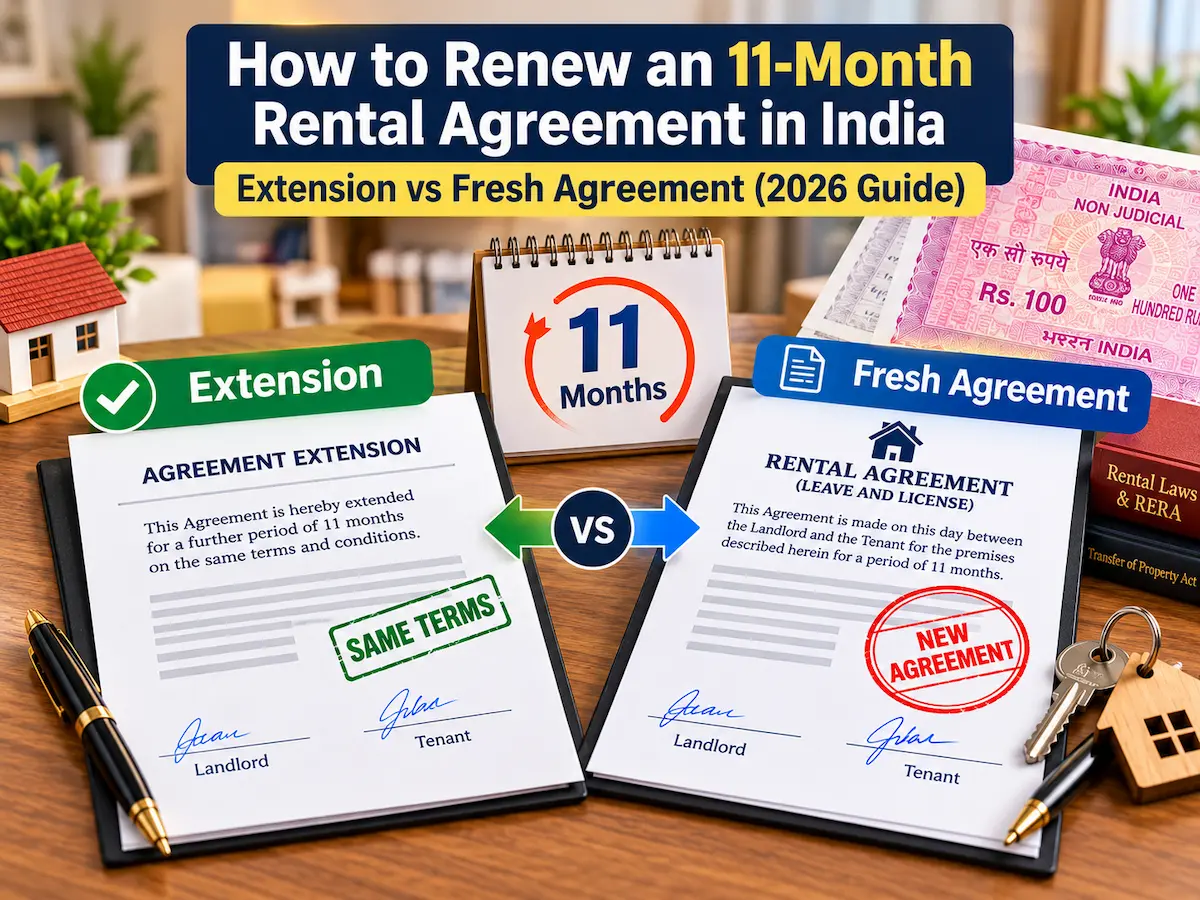
In India's bustling urban rental markets—from Bengaluru and Mumbai to Delhi NCR and Chennai—the 11-month rental agreement is the undisputed gold standard for residential leasing. By executing an agreement for 11 months rather than 12 months or longer, landlords and tenants legally avoid the mandatory registration requirement under Section 17(1)(d) of the Registration Act, 1908, saving thousands of rupees in registration fees and tedious visits to the Sub-Registrar's Office (SRO).
However, when the 10th or 11th month arrives, both parties face a critical legal juncture: Can we simply extend our existing agreement by signing a letter or plain paper addendum? Do we need to buy fresh stamp paper? What happens to the security deposit? And what is the standard rent escalation percentage?
In this comprehensive 2026 legal guide, we analyze the statutory provisions of the Transfer of Property Act, 1882, the Indian Stamp Act, 1899, and state tenancy laws to evaluate the pros and cons of an Extension Deed vs. a Fresh Rental Agreement, outlining the exact step-by-step renewal protocol to keep you legally protected.
Table of Contents
- The 11-Month Clock: Efflux of Time & Tenancy Expiry
- Option A vs. Option B: Extension Deed vs. Fresh Agreement
- The Dangerous Trap: Tenancy by Holding Over (Section 116)
- Standard Rent Escalation Benchmarks (5% to 10%)
- Security Deposit Rollover & Top-Up Accounting
- Step-by-Step 3-Minute Online Renewal Protocol
- Essential 5-Point Renewal Checklist for 2026
The 11-Month Clock: Efflux of Time & Tenancy Expiry
Under Section 111(a) of the Transfer of Property Act, 1882, a lease of immovable property determines (expires automatically) by efflux of the time limited thereby. This means that on the 330th day (11 months from execution), your rental contract legally ceases to exist.
Once the agreement expires:
- The tenant no longer holds a contractual license or lease to occupy the premises.
- Clauses governing lock-in periods, notice periods, and maintenance obligations lose direct contractual enforceability.
- The landlord cannot easily deduct repair costs or unpaid utility bills under the terms of an expired contract without entering civil litigation.
To avoid this legal vacuum, renewal discussions must commence at least 30 to 45 days prior to the expiry date.
Option A vs. Option B: Extension Deed vs. Fresh Agreement
When parties decide to continue the tenancy, there are two primary methods to regularize the arrangement:
| Feature / Parameter | Option A: Extension Deed / Addendum | Option B: Fresh 11-Month Agreement (Recommended) |
|---|---|---|
| Legal Nature | A supplementary rider amending the expiry date of the original lease. | A brand-new, standalone contract with freshly updated terms. |
| Registration Risk | High Risk: If cumulative term exceeds 11 months, courts may deem it a multi-year unregistered lease! | Zero Risk: Resets the 11-month non-registration statutory exemption completely. |
| Stamp Paper Requirement | Requires fresh stamp paper (e.g., ₹50–₹100) under state stamp acts. | Requires state-prescribed non-judicial e-Stamp paper (₹20 to ₹500 depending on state). |
| Updating Clauses | Cumbersome; requires cross-referencing old clauses with new amendments. | Seamless: Modifies rent, maintenance, parking, and rules in one unified draft. |
| Bank & HRA Acceptance | Frequently rejected by corporate HR, IT departments, and banks due to fragmented papers. | 100% Accepted everywhere for HRA exemptions, passport renewal, and bank KYC. |
⚠️ The Extension Deed Registration Trap:
If you execute an Extension Deed that extends an 11-month agreement for another 11 months without registering it, tax authorities or opposing counsel can argue that the total lease duration is 22 months. Under Section 17(1)(d) of the Registration Act, 1908, any lease exceeding 1 year MUST be registered at the Sub-Registrar's Office. If unregistered, Section 49 renders it inadmissible as primary evidence of tenancy. Executing a fresh agreement completely eliminates this legal risk.
The Dangerous Trap: Tenancy by Holding Over (Section 116)
Many landlords and tenants simply do nothing when month 11 ends: the tenant continues transferring rent via UPI, and the landlord continues accepting it without executing any renewal paperwork. In Indian property law, this is termed a Tenancy by Holding Over under Section 116 of the Transfer of Property Act, 1882.
While Section 116 treats the occupancy as a month-to-month tenancy by implication, it creates immense vulnerabilities:
- 15-Day Termination Notice: Under Section 106 of the Transfer of Property Act, a month-to-month tenancy can be terminated by either party with just 15 days of written notice, stripping the tenant of stability and the landlord of guaranteed rental yield.
- Loss of Lock-in & Penalties: If the original agreement contained a 6-month lock-in or forfeiture penalties for early departure, those clauses do not automatically survive into a holding-over tenancy.
- Eviction Complications: In summary eviction proceedings before Rent Tribunals, proving breach of specific terms (such as unauthorized pets, commercial usage, or subletting) becomes nearly impossible without an active, signed contract.
To understand the full legal mechanics of 11-month validity, read our core analysis: Why 11-Month Rental Agreements? Legal Validity & Court Precedents.
Standard Rent Escalation Benchmarks (5% to 10%)
Rent escalation is often the most sensitive part of the renewal negotiation. In Indian metropolitan cities, standard market conventions and legislative frameworks prescribe clear benchmarks:
- Standard Residential Hike (5% to 8%): In tier-1 cities (Bengaluru, Pune, Chennai, Hyderabad, Delhi NCR), standard annual rent escalation for residential apartments ranges between 5% and 8%.
- Commercial Premises (7% to 10%): For commercial shops, offices, and warehouses, annual escalation typically ranges between 7% and 10%, or a compound 15% hike every 3 years.
- Model Tenancy Act, 2021 Norms: Under Section 9 of the Model Tenancy Act, rent revisions must be mutually agreed upon in writing. A landlord must give at least 3 months' written notice before increasing the rent, and the tenant is presumed to accept unless a formal disagreement notice is delivered.
For a detailed breakdown of rent hike regulations and court guidelines, explore our pillar guide: Annual Rent Increment Percentage Rules in India.
Security Deposit Rollover & Top-Up Accounting
A frequent dispute during renewal is how to handle the existing security deposit. The golden rule is simple: The landlord does NOT refund the deposit, nor does the tenant pay a full fresh deposit. Instead, the deposit is "carried over" with a top-up adjustment.
The Deposit Rollover Calculation:
Suppose the tenant paid ₹1,00,000 as an interest-free refundable deposit based on an initial rent of ₹20,000 (5 months' rent). Upon renewal, the rent increases by 5% to ₹21,000.
- If the landlord maintains a strict 5-month deposit ratio, the new deposit requirement is ₹1,05,000 (5 × ₹21,000).
- The tenant pays an incremental Top-Up Deposit of ₹5,000.
- The new agreement explicitly acknowledges: "The Landlord acknowledges receipt of ₹1,00,000 previously paid under Agreement dated DD/MM/YYYY, plus an additional sum of ₹5,000 paid via NEFT/UPI on DD/MM/YYYY, totaling ₹1,05,000 as the continuing security deposit."
This explicit acknowledgement clause prevents either party from claiming that the original deposit was forfeited or unaccounted for when the tenancy eventually concludes.
Step-by-Step 3-Minute Online Renewal Protocol
Renewing your agreement on LetOutAgree takes less than 3 minutes:
- Step 1: Initiate Fresh Draft: Head to LetOutAgree Residential Agreement and select your property state.
- Step 2: Enter Parties & Property Details: Retain the existing landlord and tenant KYC details, updated mobile numbers, and property address.
- Step 3: Update Financials & Dates: Enter the new 11-month lease commencement date (the day immediately following the old agreement's expiry), the revised monthly rent, and the consolidated security deposit figure.
- Step 4: Free Live Preview & Instant PDF Download (₹49): Review the complete formatted legal draft on screen, complete the secure ₹49 payment, and download the print-ready A4 PDF immediately.
- Step 5: Print on Fresh e-Stamp Paper: Attach your state's required e-Stamp paper (or print onto e-Stamp margin paper) and collect signatures from both parties and two witnesses.
Essential 5-Point Renewal Checklist for 2026
Before executing your renewed agreement, review this quick checklist:
- ✅ Date Continuity: Ensure the new lease commences on the exact day after the prior lease terminates, preventing any gap in legal occupancy.
- ✅ Fresh e-Stamp Certificate: Never reuse or staple an old e-Stamp certificate; state stamp duty is single-use and non-transferable.
- ✅ Explicit Deposit Carryover Clause: Clearly document the exact rupee amount carried over from the initial lease.
- ✅ Updated Inventory & Appliance Condition: If new appliances or furniture were added during year one, update the property inventory schedule.
- ✅ Two Independent Witnesses: Execute in the presence of two adult witnesses with contact details to ensure evidentiary compliance under Section 68 of the Indian Evidence Act.
This article is for informational purposes only and does not constitute legal advice. Please consult a qualified legal professional for advice specific to your situation.



Comments (0)
Login to leave a comment.