
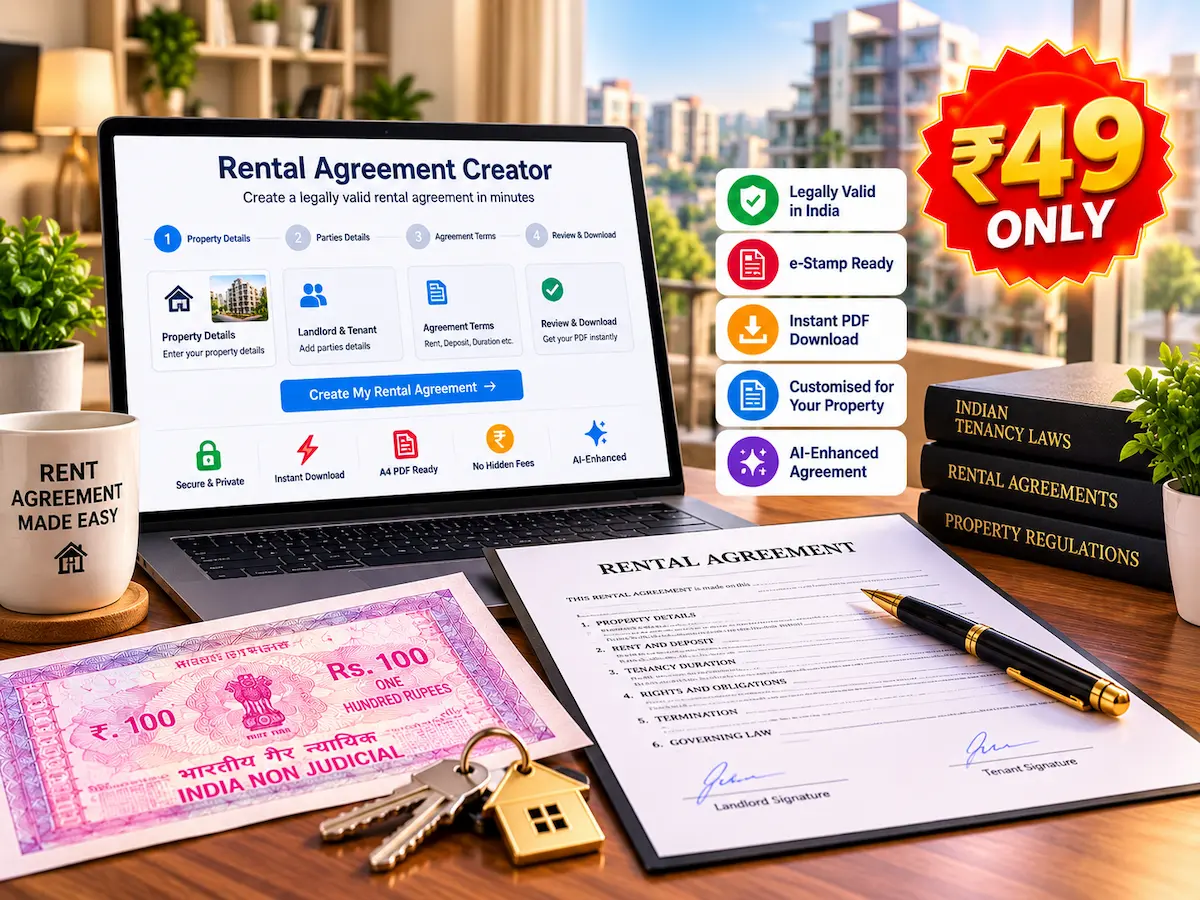
Executing a rental agreement in India has historically been one of the most frustrating errands for tenants and property owners alike. The traditional routine is familiar to millions: taking half a day off work, travelling to crowded district court complexes or Sub-Registrar Offices (SROs), bargaining with unaccredited document writers, purchasing non-judicial physical stamp papers from local court vendors, and paying anywhere between ₹500 and ₹1,500+ for a boilerplate contract filled with typographical errors and ambiguous legal clauses.
Fortunately, India's ongoing digital governance revolution—anchored by Stock Holding Corporation of India Limited (SHCIL) e-Stamping portals, state registration reforms, and legal-tech automation—has fundamentally transformed this ecosystem. Today, you no longer need to spend hours in a court hallway or wait 3 to 5 days for a portal to courier an agreement to your doorstep at inflated rates.
Whether you are a tenant moving into a new apartment in Bengaluru, a landlord leasing out a commercial shop in Pune, or an NRI managing residential property from abroad, you can now draft an attorney-verified, state-compliant rental agreement online from your mobile phone or laptop in under 3 minutes.
In this comprehensive 2026 legal guide, we walk you through the end-to-end process of creating a rental agreement online in India: essential documentation, choosing the right agreement structure, state-by-state stamp duty norms, how to attach e-Stamp certificates, and how LetOutAgree lets you generate an instant, court-ready PDF contract for a flat fee of just ₹49.
Create Your Legal Rental Agreement Online in 3 Minutes
Draft an attorney-vetted, state-compliant rental agreement online. Instant live screen preview before payment, custom clauses for all 28 Indian states, and instant print-ready A4 PDF download formatted perfectly for e-Stamp attachment. No sign-up required to start.

1. What Documents and Details Do You Need Before Starting?
Creating an online rental agreement takes only a few minutes when you have all the required factual details ready at hand. Unlike manual drafting where omissions require re-typing the whole document, online generators format your covenants dynamically.
Ensure you have the following information before you start your digital draft:
A. Landlord & Tenant Identifying Information
- Full Legal Names: As recorded on official government photo ID (Aadhaar Card, PAN Card, or Passport). Avoid nicknames or abbreviations.
- Father's / Husband's Name: Mandatory in legal deed recitals across Indian courts for clear identification (e.g., "S/o, D/o, or W/o").
- Permanent Address: Permanent residential address of both parties (often distinct from the leased property address).
- Contact Information: Active phone numbers and email addresses for digital correspondence and notice service.
- PAN Details: Critical if annual rent exceeds ₹1,00,000 (₹8,333/month), as tenants need the landlord's PAN to claim House Rent Allowance (HRA) tax exemption under Section 10(13A).
B. Property Description & Specifics
- Full Municipal Address: Flat/House number, floor, building/society name, street/road name, locality, city, state, and PIN code.
- Property Demarcation: Whether the lease covers the entire premises, a single floor, an independent bedroom with shared amenities, or a commercial shop.
- Fittings, Fixtures & Inventory: An itemized schedule of existing ceiling fans, geysers, air conditioners, electrical fittings, and furniture condition to eliminate deposit disputes upon move-out.
C. Financial Terms & Commercial Covenants
- Monthly Rent Amount: Stated in both numbers and words (e.g., ₹22,000 / Twenty-Two Thousand Rupees).
- Rent Due Date: Standardly specified on or before the 5th or 10th of every English calendar month.
- Security Deposit Amount & Refund Window: Total refundable interest-free deposit and the exact timeline for its return upon lease termination (e.g., within 15 to 30 days post-inspection).
- Maintenance & Utility Charges: Clearly delineating who pays the monthly Resident Welfare Association (RWA) society maintenance, electricity bills, water meters, and piped gas charges.
D. Tenure, Lock-in & Termination Rules
- Commencement & Expiry Date: Exact date tenancy begins and ends.
- Tenure Length: Standardly 11 months for non-registered contracts (read why 11 months is standard in Section 2).
- Lock-in Period: Minimum mandatory duration (e.g., 3, 6, or 11 months) during which neither party can terminate the agreement without penalty.
- Notice Period: Advance written notice required by either party to terminate the contract (standardly 1 month or 30 days).
- Annual Escalation Percentage: Stated renewal increment (standardly 5% to 10% per annum).
2. Choosing the Right Agreement Type: 11-Month Tenancy vs. Lease Deed
Before creating your agreement online, it is crucial to understand the legal nature of the contract you are executing under Indian jurisprudence.
| Agreement Structure | Governing Statute | Registration Mandate | Best Suited For |
|---|---|---|---|
| 11-Month Tenancy Agreement | Indian Contract Act, 1872 & State Stamp Acts | Optional / Exempt under Sec 17(1)(d) Registration Act | Standard residential apartments, bachelor tenancies, student rentals, 1-year family lets. |
| Leave & License Agreement | Section 52, Indian Easements Act, 1882 | Compulsory in Maharashtra (Sec 55 MRC Act); Optional elsewhere if ≤11 mos | Landlords seeking maximum possession protection; prevents tenant from claiming tenancy rights. |
| Long-Term Lease Deed (>11 Months) | Section 105, Transfer of Property Act, 1882 | Compulsorily Registrable at Sub-Registrar Office | Commercial offices, retail showrooms, long-term 3 to 5-year corporate leases. |
The 11-Month Exemption Explained
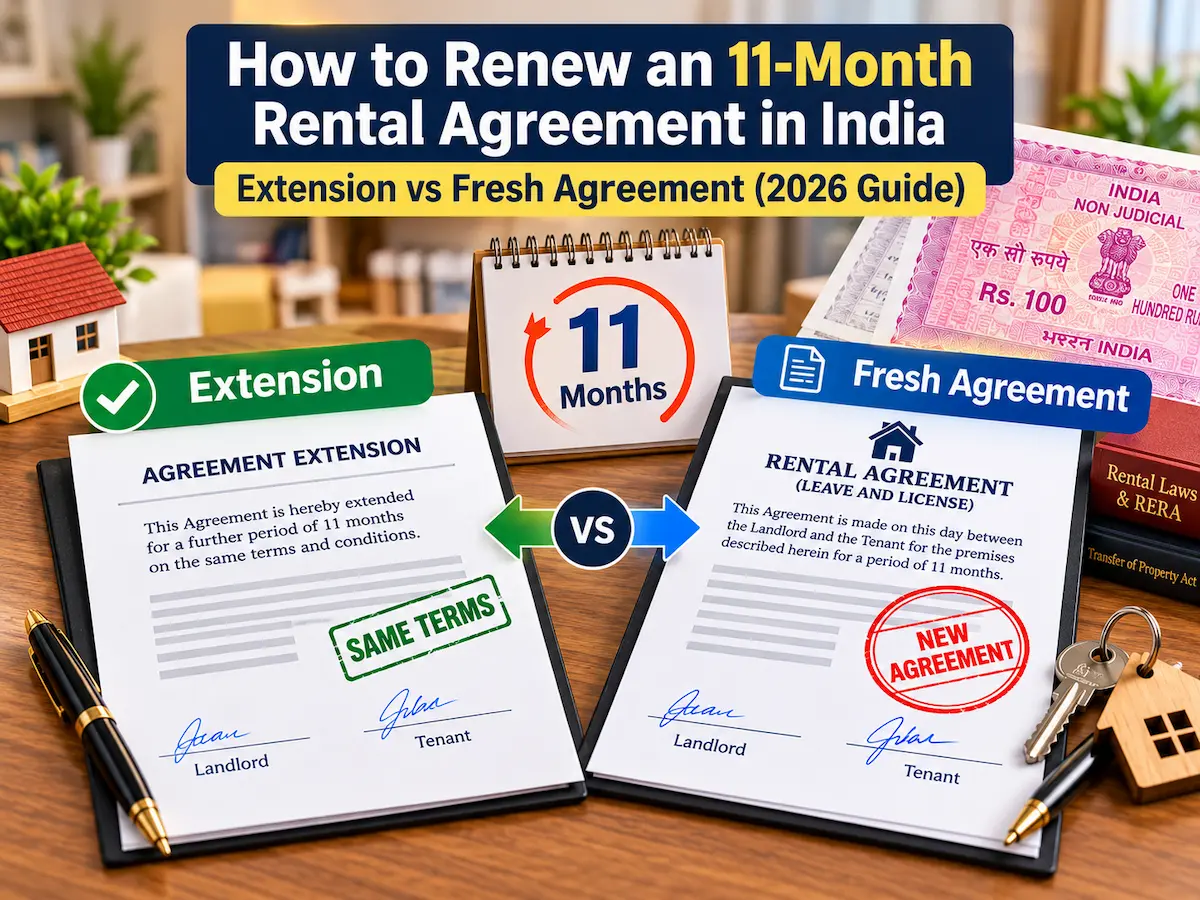
Under Section 17(1)(d) of the Registration Act, 1908, any lease of immovable property from year to year, or for any term exceeding one year, or reserving a yearly rent, must be compulsorily registered at the local Sub-Registrar Office. An agreement drafted for a term of exactly 11 months legally bypasses this compulsory registration mandate.
An 11-month agreement executed on proper state non-judicial stamp paper and attested by a Notary Public is 100% admissible as secondary evidence in court under Section 49 of the Registration Act and is universally accepted by banks, HR payroll departments, and municipal utilities.
3. State-Wise Stamp Duty & e-Stamping Rates (2026 Ready)
Stamp duty is a state subject governed by the respective State Stamp Acts. For your online rental agreement to hold evidentiary validity in a court of law under Section 35 of the Indian Stamp Act, 1899, it must be affixed with the requisite value of non-judicial stamp duty.
Below is a breakdown of stamp duty denominations and e-stamping methods across major Indian states:
| State / Territory | 11-Month Notarized Stamp Duty | Official e-Stamp Portal | Key Statutory Nuance |
|---|---|---|---|
| Karnataka (Bangalore) | ₹100 (or 0.5% of total annual rent + deposit) | SHCIL / Kaveri Online Services | Physical non-judicial stamps are banned; e-Stamping via SHCIL is mandatory. |
| Maharashtra (Mumbai / Pune) | 0.25% of total rent + non-refundable deposit | IGR Maharashtra / GRAS Portal | Under Section 55 of Maharashtra Rent Control Act, registration is mandatory for all terms. |
| Tamil Nadu (Chennai) | ₹20 to ₹100 non-judicial stamp | SHCIL / TN Tenancy Portal | TN Regulation of Rights and Responsibilities Act requires mandatory tenancy registration. |
| Delhi NCR | ₹100 non-judicial stamp duty | SHCIL Delhi e-Stamping | 100% computerized e-Stamping available via authorized bank collection centers. |
| Uttar Pradesh (Noida / Lucknow) | ₹100 non-judicial stamp paper | SHCIL UP / e-Kosh Portal | Tenant police verification via UPCOP app is strongly enforced across Noida and Ghaziabad. |
| West Bengal (Kolkata) | ₹10 to ₹100 non-judicial stamp | GRIPS 2.0 (Finance Dept) | Governed by WB Premises Tenancy Act; GRIPS e-Challan with GRN number accepted. |
| Gujarat (Ahmedabad) | ₹300 non-judicial stamp duty | Garvi Gujarat / SHCIL | Gujarat mandates statutory ₹300 non-judicial stamp paper for rental agreements. |
| Telangana & Andhra Pradesh | ₹100 non-judicial stamp paper | IGRS Telangana / AP Meebhoomi | Non-judicial stamps purchased from authorized vendors or IGRS e-Stamping counters. |
For a detailed walkthrough on buying and verifying state e-Stamp certificates, read our comprehensive State-Wise e-Stamp Paper Purchasing Guide.
4. How to Create Your Agreement Online on LetOutAgree (5-Step Walkthrough)
At LetOutAgree, we engineered a frictionless 5-step generator that lets you draft, customize, preview, and download your complete, court-ready rental agreement in less than 3 minutes for a flat fee of ₹49. No subscription traps, no delivery delays, and no lawyer consultation fees.
Here is how the 5-step process works:
-
Step 1: Select Your Document Category
Choose from our tailored contract wizards depending on your exact property type:- Residential Rental Agreement (Flats, independent houses, villas, bachelor rooms)
- Commercial Shop Rental Agreement (Retail shops, boutiques, commercial storefronts)
- Commercial Office & Space Agreement (Offices, IT suites, godowns, industrial spaces)
-
Step 2: Enter Parties, Property & Commercial Terms
Fill in the guided online form with Landlord details, Tenant details, the complete rental address, monthly rent amount, security deposit, lock-in period, and notice period. Our dynamic engine formats statutory legal recitals automatically in real time. -
Step 3: Review the Free Live Screen Preview
Unlike legacy portals that require you to pay upfront before seeing the document, LetOutAgree provides a 100% free, interactive live preview of your full agreement text right on your screen. Verify spellings, check dates, and make instant edits with zero friction. -
Step 4: Complete the Flat ₹49 Payment
Once satisfied with the draft preview, proceed to our secure, 256-bit encrypted checkout powered by Razorpay. Pay flat ₹49 using any preferred payment method: UPI (Google Pay, PhonePe, Paytm), Credit/Debit Cards, or Net Banking. There are no hidden convenience fees or delivery markups. -
Step 5: Instant Print-Ready A4 PDF Download
Your high-resolution, print-ready PDF is generated immediately and downloaded to your device in seconds. The PDF is precision-engineered with calibrated top margins on Page 1 to ensure seamless physical printing onto standard non-judicial stamp paper or attachment to an e-Stamp certificate.
Draft Your Rental Agreement in 3 Minutes
Create a legally valid rental agreement online with instant print-ready download.
Start Agreement Now (₹49)
5. How to Execute, Sign & Notarize Your Downloaded PDF
Once you have downloaded your print-ready PDF from LetOutAgree, follow these three simple steps to complete its statutory execution:
Method 1: Attaching to an e-Stamp Certificate (Most Common & Modern)
- Obtain the e-Stamp Certificate: Purchase an e-Stamp certificate of the appropriate value (e.g., ₹100 in Karnataka/Delhi, ₹300 in Gujarat) from your nearest SHCIL branch, designated nationalized bank (e.g., SBI, Canara Bank, Union Bank), or online portal.
- Print the LetOutAgree PDF: Print your downloaded agreement onto clean, standard A4 white paper (80+ GSM recommended for legal longevity).
- Collate Document: Place the official e-Stamp certificate as Page 1. Follow with the printed LetOutAgree agreement as Page 2 onward.
- Signatures: The Landlord and Tenant sign across the bottom of every page and provide full legal signatures on the execution page.
- Witness Attestation: Two independent adult witnesses sign the execution page along with their full names and addresses.
Method 2: Notarization by a Notary Public
For an 11-month agreement, getting the document notarized by a licensed Notary Public provides solid evidentiary authentication. The Notary verifies identity proofs (Aadhaar/PAN), witnesses the signatures, affixes their official notarial stamp and red seal, and enters the transaction into their official Notarial Register.
To learn the critical legal differences between simple notarization and full Sub-Registrar registration, read our comprehensive guide: Notarized vs. Registered Rental Agreement: Legal Differences & Validity.
6. Seven Critical Clauses You Must Never Overlook
Even when creating an agreement online, ensuring that specific protective clauses are active prevents 90% of all future tenancy disputes. Check that your agreement includes:
- Explicit Security Deposit Refund Window: Must specify a time-bound refund (e.g., within 15 to 30 days) after handing over vacant possession, subject only to unpaid utility bills.
- Normal Wear and Tear Exclusion: Strictly prevents landlords from deducting painting or routine aging costs from the security deposit (read our guide on Handling Unlawful Security Deposit Deductions).
- Clear Escalation Cap: Capping annual rent increases at a mutually agreed 5% to 10% prevents unilateral double-digit rent spikes upon renewal.
- Lock-in Period vs. Notice Period: A clearly defined lock-in period (e.g., 6 months) followed by a 1-month notice period prevents abrupt terminations.
- Landlord's Right of Inspection with Prior Notice: Mandates at least 24 hours' advance notice before the landlord or their agent enters the premises for repairs.
- Prohibition on Unauthorized Subletting: Forbids the tenant from subleasing, operating an unauthorized commercial business, or running a PG/Airbnb without the owner's written consent.
- Dispute Resolution & Jurisdiction: Designates the local municipal civil court jurisdiction to prevent cross-district forum shopping in case of conflict.
For a detailed breakdown of all 15 essential covenants, refer to our 15 Crucial Rental Agreement Clauses Checklist.
7. LetOutAgree vs. Legacy Portals vs. Offline Court Typists
Why are hundreds of tenants and property owners switching to LetOutAgree every day? Here is a clear, objective comparison:
| Feature / Parameter | LetOutAgree (LOA) | Legacy Portals (NoBroker, etc.) | Offline Court Typists |
|---|---|---|---|
| Pricing | Flat ₹49 (Transparent) | ₹399 – ₹1,499+ (High markup) | ₹500 – ₹1,500 (Bargaining required) |
| Turnaround Time | Instant (Under 3 Minutes) | 3 to 5 Days (Courier delivery) | Half-day to 1 full working day |
| Live Screen Preview | 100% Free Before Payment | Pay first, preview later | None (Drafted live on typewriter) |
| National Coverage | All 28 States & 8 UTs | Select Tier-1 Metros only | Single court jurisdiction only |
| Sign-Up Requirement | No account needed to start | Mandatory account & spam calls | Physical presence mandatory |
This article is for informational purposes only and does not constitute legal advice. Please consult a qualified legal professional for advice specific to your situation.



Comments (0)
Login to leave a comment.