
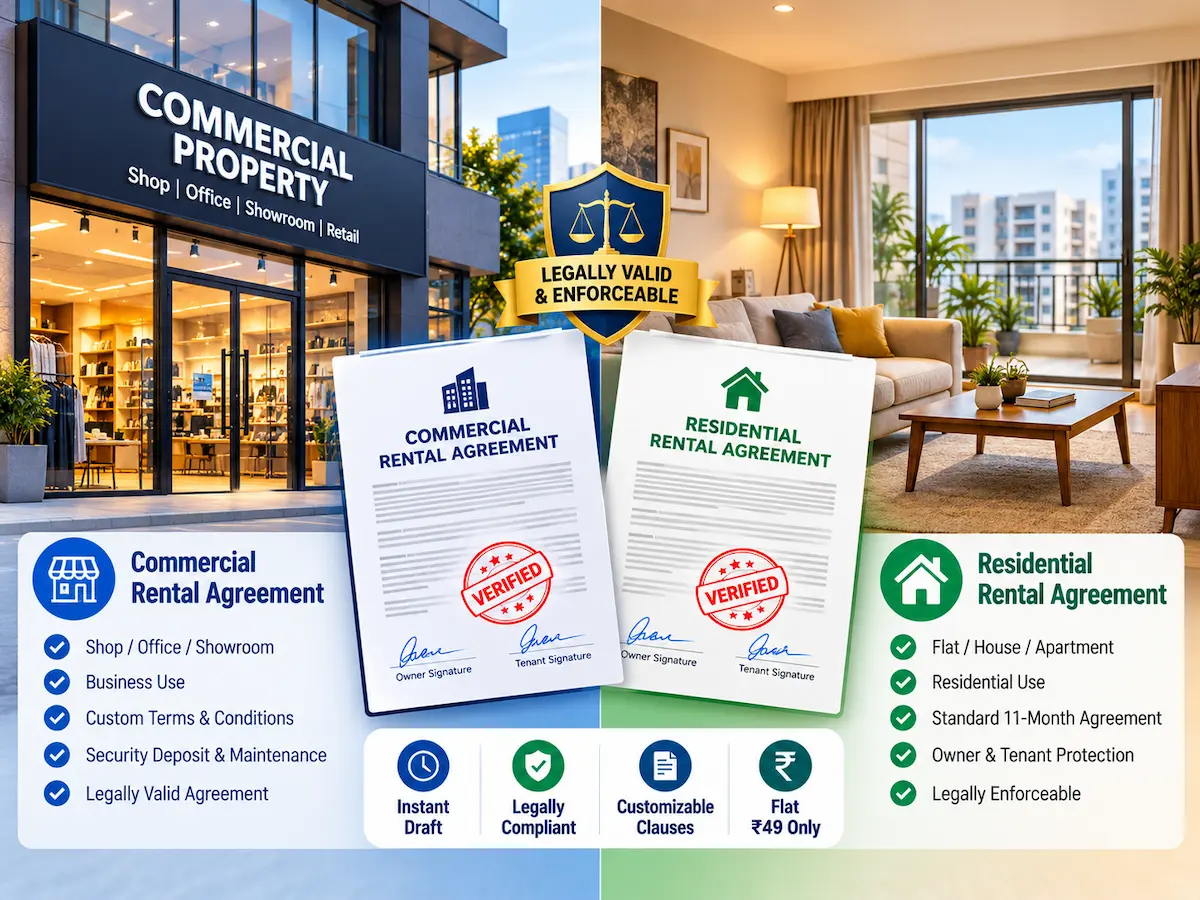
Whether you are an individual property investor renting out an apartment, a retail entrepreneur opening a boutique store, or a doctor leasing clinic premises, entering into a tenancy contract is a major financial and legal commitment. However, one of the most frequent and costly mistakes property owners and tenants make is assuming that a commercial shop or office lease is simply a residential rent agreement with higher numbers.
In Indian property law, treating a commercial lease like a standard residential rental agreement is dangerous. Indian courts and tax authorities draw sharp statutory distinctions between residential dwelling and commercial business occupancy. While residential tenancies are heavily cushioned by consumer-style protections, basic human rights principles, and rent control safeguards, commercial leases are treated strictly as arm's-length corporate contracts where parties are presumed to possess equal bargaining power and legal sophistication.
Consequently, commercial lease deeds entail significantly higher stamp duty liabilities, mandatory registration under Section 17 of the Registration Act, complex 18% Goods and Services Tax (GST) implications, stringent 3 to 5-year lock-in obligations, and specialized dispute resolution mechanisms under the Commercial Courts Act, 2015.
In this comprehensive 2026 legal guide, we break down the 7 fundamental differences between commercial leases and residential rental agreements in India, outline statutory compliance requirements, and show how you can draft attorney-grade, customized agreements on LetOutAgree for flat ₹49.
Draft an Attorney-Grade Lease Agreement in 3 Minutes
Whether leasing a residential 2BHK flat or a prime commercial retail shop, generate a legally verified agreement with pre-structured stamp duty, GST, lock-in, and notice clauses for flat ₹49.
Quick Comparison: Commercial Lease vs Residential Rent Agreement
The following summary table highlights the structural, financial, and legal differences between both formats under Indian property laws:
| Parameter | Residential Rental Agreement | Commercial Lease Deed |
|---|---|---|
| 1. Statutory Purpose | Personal living, family dwelling, or residential accommodation only. | Retail commerce, corporate offices, clinics, warehousing, or business trade. |
| 2. Typical Tenure | Typically 11 months (Leave and License) or 1 to 2 years. | Long-term (typically 3, 5, or 9 years with renewal options). |
| 3. Registration Requirement | Optional for ≤ 11 months under Section 17(1)(d) (except in Maharashtra). | Compulsory registration at Sub-Registrar Office (SRO) if lease tenure exceeds 11 months. |
| 4. Stamp Duty Calculation | Flat nominal stamp duty (e.g., ₹100 to ₹500 in most Indian states). | Percentage-based (typically 1% to 4% of total average annual rent + deposit). |
| 5. GST Applicability | 100% Exempt (when rented to individuals for dwelling). | 18% GST applies (if landlord annual turnover > ₹20 Lakhs). |
| 6. Lock-in Period | Usually 1 to 3 months (or omitted), with 1-month notice period. | Strict 1 to 3 years lock-in with mandatory liquidated damages. |
| 7. Fit-outs & Alterations | Minor tenant repairs; landlord maintains civil structure and fittings. | Tenant handles extensive interior fit-outs, electrical cabling, HVAC & signage. |
The 7 Core Legal & Commercial Differences in Detail
1. Statutory Purpose & Municipal Zoning Compliance
The foremost distinction lies in municipal land use zoning laws. A residential property is designated under municipal master plans (BDA, BMC, CMDA, DDA) strictly for human habitation. Operating an unauthorized commercial business, cloud kitchen, or customer-facing retail shop inside a residential apartment violates local municipal zoning laws and triggers property sealing orders by municipal authorities.
Conversely, a commercial property must carry valid commercial sanctions, an official Occupancy Certificate (OC), and commercial power/water tariff lines. A commercial lease deed must explicitly authorize the specific trade (e.g., "retail electronics showroom", "pathology lab", or "IT software office") to enable the tenant to obtain local Trade Licenses, GST Registration, and Shops & Establishments Act Licenses.
2. Lease Tenure & Registration Mandates (Section 17 Registration Act)
Tenure structures reflect the underlying economics of both arrangements:
- Residential Tenancies: Because residential tenants value flexibility and landlords wish to avoid complex tenancy rights, the vast majority of residential agreements are drafted as 11-Month Leave and License Agreements. Under Section 17(1)(d) of the Registration Act, 1908, leases under 1 year do not require compulsory registration at the Sub-Registrar Office (except in Maharashtra).
- Commercial Leases: Business tenants invest lakhs or crores of rupees into customized interior fit-outs, display shelving, air conditioning, and brand building. Therefore, commercial contracts typically run for 3, 5, or 9 years (with 3-year rent escalation cycles). Because commercial leases exceed 11 months, registration at the Sub-Registrar Office is legally mandatory under Indian law. An unregistered multi-year commercial lease is inadmissible as evidence of lease terms in court under Section 49 of the Registration Act.
3. Stamp Duty & Registration Fee Computations
The financial friction of stamping a commercial lease is substantially higher than a residential contract:
- Residential Agreements: Most Indian states levy nominal fixed stamp duty (e.g., ₹100 to ₹500 in Delhi, Tamil Nadu, and Karnataka) for 11-month agreements.
- Commercial Leases: State Stamp Acts calculate commercial stamp duty on an ad valorem percentage formula based on the Total Annual Rent × Tenure + Refundable Security Deposit. For example, a 5-year commercial shop lease with ₹1,00,000 monthly rent in Karnataka or Maharashtra can easily attract ₹35,000 to ₹75,000 in statutory stamp duty and registration fees.
4. Tax Framework: GST (18%) and Withholding TDS
Tax compliance mechanisms for commercial and residential premises operate under completely different statutory provisions:
| Tax Dimension | Residential Rental Agreement | Commercial Lease Deed |
|---|---|---|
| GST Liability | Exempt when let out to an unregistered individual for residential dwelling. | 18% GST mandatory if landlord's aggregate business turnover exceeds ₹20 Lakhs per annum. |
| TDS Withholding Rate | 5% under Section 194-IB (only if rent exceeds ₹50,000/month by individual/HUF). | 10% under Section 194-I (if total annual commercial rent exceeds ₹2,40,000). |
| Input Tax Credit (ITC) | Not applicable to residential tenants. | Commercial tenants registered under GST can claim 100% ITC on the 18% GST paid. |
5. Lock-in Periods & Early Termination Penalties
Because businesses require operational stability, Lock-in Periods are central to commercial leases:
- In a residential rental agreement, the lock-in period is typically brief (1 to 3 months) or entirely omitted. Either party can terminate by giving a 1-month written notice.
- In a commercial lease, landlords invest heavily in brokerage, tenant-specific plumbing/electrical modifications, and face months of vacancy between business tenants. Consequently, commercial contracts enforce strict 1-year to 3-year lock-in periods. If the tenant vacates prematurely before the lock-in expires, courts uphold liquidated damages covenants compelling the tenant to pay rent for the remaining unexpired lock-in months.
6. Maintenance, Structural Fit-outs & Bare Shell Handover
Who pays for what inside the leased premises differs radically between both formats:
- Residential Units: Delivered in "move-in ready" condition. The landlord is legally responsible for structural upkeep, roof leakages, external painting, and primary plumbing, while the tenant handles minor wear and tear (see our Painting & Repair Responsibilities Guide).
- Commercial Premises: Frequently handed over as a "Bare Shell" (concrete floor, unplastered walls, power terminal) or "Warm Shell". The commercial tenant bears complete financial and legal liability for false ceilings, flooring, electrical load enhancement, HVAC ducting, fire safety NOCs, and interior branding. The lease deed must explicitly specify whether fit-outs must be restored to original state upon lease expiration.
7. Rent Escalation Cycles & Legal Dispute Resolution
How rent increases and how disputes are settled in court represent the final key divergence:
- Rent Escalation: Residential rent escalates annually by 5% to 10% upon 11-month contract renewal. Commercial leases follow structured compounding cycles—most commonly a 12% to 15% escalation every 3 years, reflecting long-term business forecasting.
- Court Recourse: Residential disputes fall under local Small Causes Courts, Civil Judges, or Rent Authorities. Commercial lease disputes with a specified value exceeding ₹3 Lakhs are adjudicated by specialized Commercial Courts under the Commercial Courts Act, 2015, with mandatory pre-institution mediation under Section 12A, ensuring significantly faster adjudication than traditional civil suits.
Draft Residential or Commercial Agreements on LetOutAgree
Whether you are leasing a residential flat or commercial shop, using a generic internet template exposes you to tax scrutiny, invalid notices, and unenforceable penalty clauses. LetOutAgree offers specialized, attorney-vetted drafting engines tailored specifically for both property classes:
- Select Your Workflow:
- For apartments, villas, and independent houses: Choose Residential Rental Agreement.
- For retail shops, showrooms, clinics, and corporate offices: Choose Commercial Shop & Office Lease.
- Customized Contract Clauses: Automated inclusion of GSTIN declarations, Section 194-I TDS terms, commercial trade authorizations, fit-out restoration rules, and strict lock-in covenants.
- Live Free Screen Preview: Review your complete legal document on screen before paying a single rupee.
- Flat ₹49 Instant PDF Download: Securely download your print-ready high-resolution PDF calibrated for state e-Stamp paper attachment in less than 3 minutes.
This article is for informational purposes only and does not constitute legal advice. Please consult a qualified legal professional for advice specific to your situation.


Comments (0)
Login to leave a comment.