
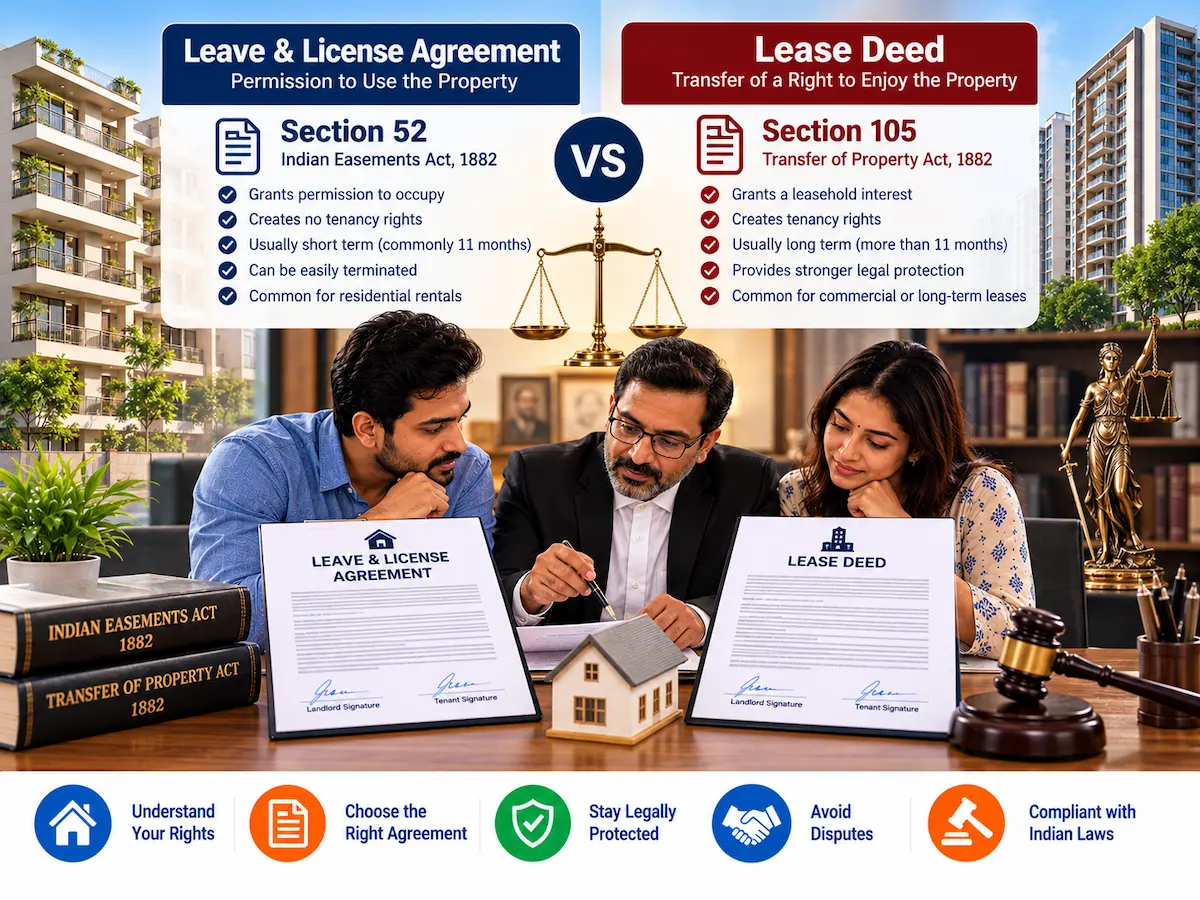
If you have ever rented an apartment in Mumbai, Pune, Bengaluru, or Delhi, you have likely noticed that the document presented to you was titled "Leave and License Agreement" rather than a "Lease Agreement" or "Tenancy Deed". The parties were not addressed as "Landlord and Tenant", but rather as "Licensor and Licensee", and the monthly payment was styled as a "License Fee" instead of "Rent".
To the untrained eye, these appear to be trivial semantic differences. However, in the eyes of Indian property law, they represent two radically different legal universes governed by entirely separate statutes: the Indian Easements Act, 1882 versus the Transfer of Property Act, 1882.
Historically, archaic rent control laws in India heavily favoured tenants. Once a person acquired legal "tenancy" under a lease, they gained statutory protection against eviction, rent increases were capped at artificial levels, and tenancies could even be passed on to legal heirs. To shield their assets from protracted, decades-long civil litigation, Indian property owners developed the Leave and License structure.
Whether you are a property owner seeking to protect your real estate investment or a tenant evaluating your legal occupancy rights, understanding these statutory differences is essential. In this comprehensive 2026 legal guide, we break down the 7 critical differences between a Leave and License Agreement and a Lease Deed, compare stamp duty implications, analyze the landmark Maharashtra statutory exception, and explain how LetOutAgree helps you draft a compliant agreement online in 3 minutes for flat ₹49.
Draft Your Legal Leave & License Agreement in 3 Minutes
Generate an attorney-vetted agreement tailored for residential or commercial properties across India. Drafted with precise legal recitals protecting property titles, preventing adverse tenancy claims, and calibrated for e-Stamping for flat ₹49.

1. What Is a Leave and License Agreement? (Section 52, Indian Easements Act)
A Leave and License Agreement is an agreement governed by Section 52 of the Indian Easements Act, 1882, which defines a license as follows:
"Where one person grants to another, or to a definite number of other persons, a right to do, or continue to do, in or upon the immovable property of the grantor, something which would, in the absence of such right, be unlawful, and such right does not amount to an easement or an interest in the property, the right is called a license."
The defining legal characteristics of a Leave and License include:
- No Transfer of Interest: The Licensor does not transfer any legal interest or proprietary right in the immovable property to the Licensee.
- Permissive Right Only: The contract merely grants a temporary, revocable personal permission (*jus in personam*) to occupy and use the premises for residential or commercial purposes.
- Juridical Possession Remains with Licensor: Under Indian law, legal possession (*animus possidendi*) remains at all times with the property owner. The occupant holds only permissive physical occupation.
- Personal Privilege: The license is purely personal to the Licensee. It cannot be sub-licensed, assigned, transferred, or inherited by family members.
2. What Is a Lease Deed? (Section 105, Transfer of Property Act)
A Lease Deed is a formal conveyance governed by Section 105 of the Transfer of Property Act, 1882, which defines a lease as follows:
"A lease of immovable property is a transfer of a right to enjoy such property, made for a certain time, express or implied, or in perpetuity, in consideration of a price paid or promised..."
The defining legal characteristics of a Lease include:
- Transfer of Property Interest: A lease creates a proprietary legal right in the property (*jus in rem*) in favor of the Lessee (tenant) that is enforceable against the whole world.
- Exclusive Legal Possession: The Lessee acquires exclusive possession of the premises, which they can defend even against the Lessor (landlord) during the lease term.
- Heritability & Transferability: Unless explicitly restricted in the lease covenant, a leasehold interest can be sub-leased, assigned, or transferred, and automatically passes to the legal heirs upon the Lessee's demise.
- Statutory Protection: Lessees enjoy substantial statutory protections under State Tenancy Acts and Section 106–116 of the Transfer of Property Act against arbitrary termination.
3. The 7 Critical Legal Differences Compared
The table below summarizes the key legal, statutory, procedural, and commercial distinctions between a Leave & License Agreement and a Lease Deed in India:
| Comparative Parameter | Leave and License Agreement | Lease Deed (Tenancy) |
|---|---|---|
| 1. Governing Law | Section 52, Indian Easements Act, 1882 | Section 105, Transfer of Property Act, 1882 |
| 2. Transfer of Property Interest | No transfer of interest; creates only a personal permissive right (*jus in personam*). | Transfers legal interest in immovable property (*jus in rem*). |
| 3. Legal Possession | Legal possession remains strictly with the Licensor (Owner). Occupant has permissive entry. | Exclusive legal possession transfers to the Lessee during the lease term. |
| 4. Eviction Process | Fast & Summary: License expires automatically; summary eviction via Competent Authority / Rent Court. | Lengthy & Complex: Requires proving statutory grounds; regular civil suit under Code of Civil Procedure (CPC). |
| 5. Subletting & Heritability | Non-transferable & Non-heritable: Terminates on licensee's death; cannot be sublet or assigned. | Transferable & Heritable: Passes to legal heirs upon lessee's death unless barred by deed. |
| 6. Registration Requirement | Optional / Exempt for ≤11 months under Sec 17(1)(d) (Compulsory in Maharashtra under Sec 55 MRC Act). | Compulsory for any term of 12 months or longer at the Sub-Registrar Office. |
| 7. Subsequent Property Sale | Does not bind subsequent property purchasers unless the new owner specifically ratifies. | Binds subsequent purchasers (new owner must honor existing registered lease terms). |
Detailed Breakdown of Key Legal Differences:
1. The Juridical Nature of Possession
The landmark Supreme Court ruling in Associated Hotels of India Ltd. v. R.N. Kapoor (AIR 1959 SC 1262) laid down the definitive test for distinguishing a lease from a license:
- If an agreement creates an interest in the property granting the occupant exclusive possession with the power to exclude even the owner, it is a lease.
- If the document merely permits another to make use of the property while legal possession and control remain with the owner, it is a license.
Because a licensee never gains legal possession, they cannot file a civil suit claiming adverse possession or tenancy rights under old Rent Control Acts.
2. Ease of Eviction: Why Landlords Insist on Leave & License
Under a Lease Deed, evicting a tenant who refuses to vacate or stops paying rent requires issuing a mandatory Section 106 notice followed by a regular civil eviction suit under the Code of Civil Procedure (CPC), which can drag on in Indian district courts for 5 to 15 years.
Under a Leave and License Agreement, once the agreed term expires or the license is terminated via written notice, the licensee's legal permission dissolves. Continued stay constitutes unlawful trespass. The property owner can seek summary eviction before the designated Rent Authority or Competent Authority, recovering possession in a fraction of the time.
3. Rights on Death of the Occupant (Heritability)
One of the greatest fears of Indian property owners is having a tenant pass away and their adult children claiming indefinite tenancy rights at nominal rent rates. A leasehold right is a proprietary property right that automatically devolves upon the lessee's legal heirs. In contrast, a license is purely personal: it terminates immediately upon the death of the licensee, and family members have no legal claim to remain in the property.
4. The Maharashtra Statutory Exception (Section 55, MRC Act)
The State of Maharashtra occupies a unique position in Indian real estate jurisprudence. Under Section 55 of the Maharashtra Rent Control Act, 1999:
- Every agreement for Leave and License or tenancy must be in writing and compulsorily registered with the Sub-Registrar / IGR Maharashtra, regardless of whether the duration is 1 month, 11 months, or 3 years.
- The statutory liability to register the agreement rests entirely upon the Licensor (landlord).
- Summary Eviction Power (Section 24): In exchange for mandatory registration, Section 24 gives Maharashtra landlords an extraordinary legal remedy: if a licensee fails to deliver vacant possession upon license expiry, the Competent Authority is empowered to issue a summary eviction order within 90 days and award double the monthly license fee as penal compensation for every month of unauthorized occupation.
To learn more about registration rules and notarization comparisons, read our guide: Notarized vs. Registered Rental Agreements in India.
5. When Should You Choose a Leave & License vs. a Lease Deed?
Choosing the correct legal document depends on the nature of your property and your commercial objectives:
Choose a Leave and License Agreement When:
- Renting Residential Properties: Standard apartments, villas, builder floors, or independent houses leased to families, working professionals, or students.
- Tenures of 11 Months or Less: In all states outside Maharashtra, an 11-month Leave & License agreement executed on requisite state e-Stamp paper avoids compulsory registration while providing ironclad title protection.
- Maximum Landlord Title Security: When the property owner wants zero risk of adverse tenancy claims or prolonged eviction litigation.
Choose a Lease Deed When:
- Commercial Leases with High Fit-Out Investment: Retail showrooms, restaurant spaces, or corporate offices where the business tenant is investing lakhs in interior construction and requires an irrevocable 3, 5, or 9-year tenure.
- Subletting or Assignment Required: When a business needs the flexibility to assign the lease or transfer rights to group entities or subsidiaries.
- Industrial & Warehousing Land: Long-term factory premises or logistics parks leased from industrial development corporations (e.g., MIDC, GIDC, KIADB).
6. How to Draft a Legally Sound Agreement on LetOutAgree
Whether you require a residential Leave & License agreement or a commercial tenancy contract, LetOutAgree makes the process fast, seamless, and legally airtight:
- Choose Your Property Category: Select our Residential Rental Generator, Commercial Shop Generator, or Commercial Space Generator.
- Fill Guided Terms: Enter Licensor, Licensee, and municipal property particulars along with monthly license fee, security deposit, and lock-in covenants.
- Review Free Live Screen Preview: Check the complete deed on your screen before making any payment.
- Instant ₹49 Payment & Download: Pay flat ₹49 via UPI (Google Pay, PhonePe, Paytm) or Card to instantly download your print-ready A4 PDF.
- Affix e-Stamp & Execute: Attach to an authentic state e-Stamp certificate, sign with two witnesses, and complete notarization or SRO registration.
To avoid dispute pitfalls, ensure your agreement incorporates our 15 Crucial Rental Agreement Clauses and clearly specifies Who Pays for Painting & Repairs.
This article is for informational purposes only and does not constitute legal advice. Please consult a qualified legal professional for advice specific to your situation.



Comments (0)
Login to leave a comment.