
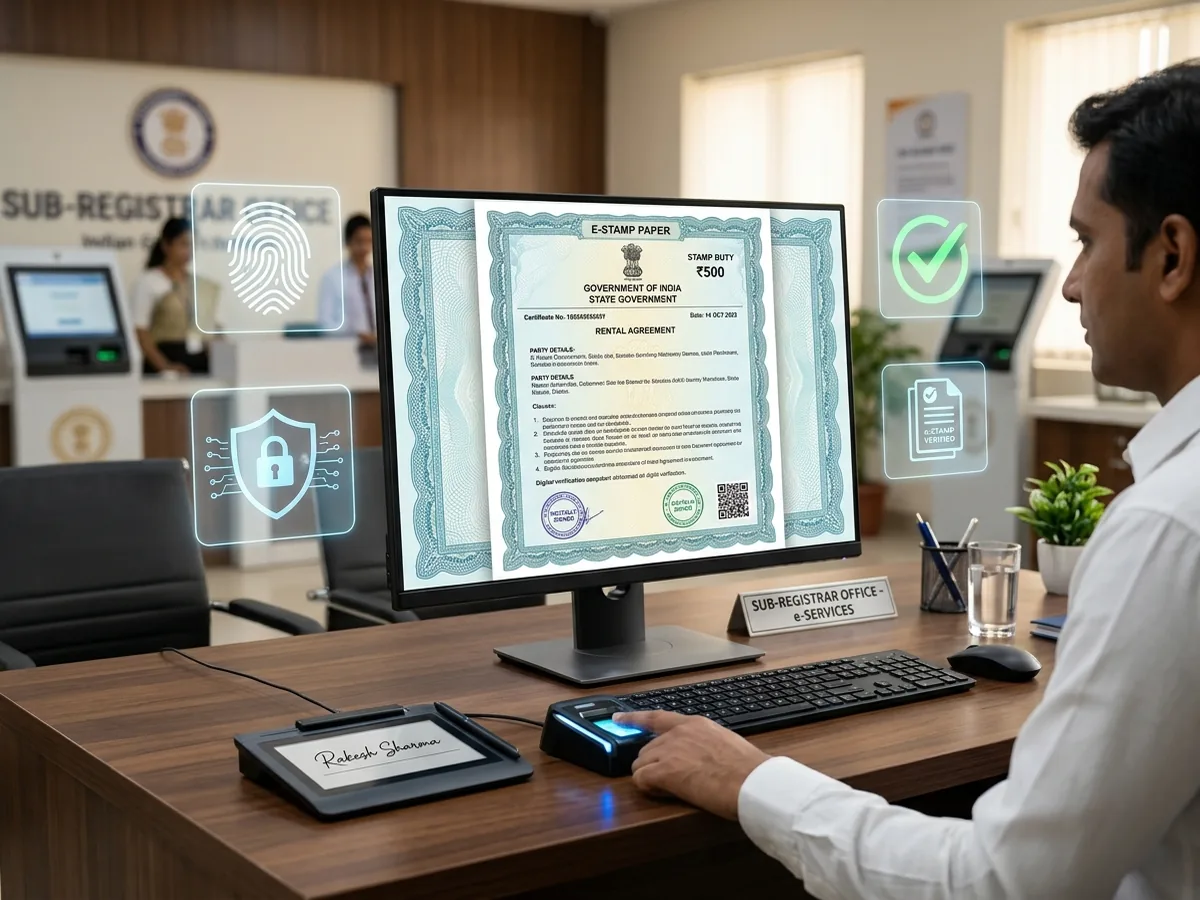
For decades, registering a rental agreement in India was synonymous with bureaucratic friction: standing in chaotic queues outside local Sub-Registrar Offices (SROs), dealing with middlemen and touts, paying arbitrary document writer commissions, and coordinating physical visits for landlords, tenants, and two adult witnesses during restricted government working hours.
In 2026, India's ongoing digital governance revolution has fundamentally transformed property leasing. State governments across the nation—spearheaded by landmark initiatives like Maharashtra's IGR e-Registration, Karnataka's Kaveri 2.0, Telangana's IGRS Digital Registration, and Delhi's SHCIL e-Stamping Portal—have ushered in Aadhaar-based biometric and OTP e-registration for rental and leave-and-license agreements.
Whether you are a busy IT professional in Bengaluru, an NRI landlord residing in Dubai or London, or a local house owner in Mumbai or Pune, digital SRO reforms allow you to execute, stamp, and officially register your rental agreement entirely from the comfort of your home. A government-registered agreement provides absolute legal evidentiary standing in court under Section 49 of the Registration Act, 1908 and complete immunity against tenancy disputes.
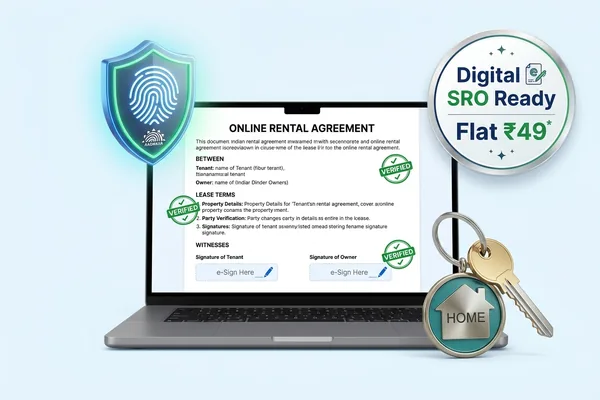
In this comprehensive 2026 guide, we explain how Aadhaar-based digital registration works, compare state-wise digital portals, detail the required hardware and biometric authentication steps, examine data privacy safeguards under the Aadhaar Act and DPDP Act 2023, and show how LetOutAgree prepares court-compliant agreement drafts ready for seamless registration for flat ₹49.
Prepare Your Court-Ready Agreement for Digital Registration
Eliminate physical SRO queues. Draft an attorney-vetted 11-month agreement pre-formatted for Aadhaar e-registration, biometric SRO submission, and state e-Stamp certificates for flat ₹49.
The Legal Framework: Why Digital SRO Registration Matters
Under Section 17(1)(d) of the Registration Act, 1908, any lease of immovable property for a period exceeding 11 months, or from year to year, is statutorily mandatory to register. Furthermore, specific state enactments—most notably Section 55 of the Maharashtra Rent Control Act, 1999—mandate that all tenancy and leave-and-license agreements, even those executed for 11 months, must be registered in writing.
Historically, compliance was abysmal because visiting the SRO was cumbersome. To solve this, state Inspector Generals of Registration (IGR) integrated with the Unique Identification Authority of India (UIDAI) and National Informatics Centre (NIC) to launch e-Registration. This electronic workflow operates under the legal validity of the Information Technology Act, 2000 (Section 10A), conferring the exact same evidentiary and legal standing as a physically executed document stamped in an SRO chamber.
Step-by-Step: How Aadhaar-Based e-Registration Works
While minor procedural variations exist across states, the overarching digital registration workflow follows a standardized 5-stage architecture:
Step 1: Agreement Preparation & Property Details Entry
The landlord and tenant formulate the terms of tenancy—including monthly rent, security deposit amount, lock-in period, society maintenance liabilities, and property boundaries. Using a robust digital generator like LetOutAgree ensures that all mandatory covenants (identification clauses, default penalties, and termination notices) are drafted with legal precision before entering government portals.
Step 2: Digital Identity Verification (Aadhaar KYC)
Both parties enter their 12-digit Aadhaar numbers on the state registration portal. The system connects securely with the UIDAI Central Identities Data Repository (CIDR) to pull verified demographic details (full legal name, date of birth, photo, and residential address). This eliminates fraudulent impersonation or fictitious tenancy claims.
Step 3: Online Payment of Stamp Duty and Registration Fees
Stamp duty and state registration charges are calculated automatically by the government portal based on property location (urban vs. rural) and annual rental turnover. Payment is completed securely via integrated state payment gateways—such as Maharashtra's GRAS (Government Receipt Accounting System) or Karnataka's K-Treasury—generating an instant e-Challan receipt.
Step 4: Biometric Authentication & Witness Verification
This is the core pillar of digital SRO authentication. The parties authenticate their execution using either:
- Biometric Fingerprint Scanner: Using an STQC-certified USB fingerprint scanner (such as Mantra MFS100 or Morpho Safran), the landlord, tenant, and two adult witnesses press their fingers to capture biometric minutiae. The UIDAI server validates the fingerprint match in real time.
- Aadhaar OTP-Based e-Sign: In states adopting next-generation paperless registration, parties whose mobile numbers are linked to Aadhaar receive a secure 6-digit Time-based One-Time Password (OTP) to execute an electronic signature.
Step 5: Automated SRO Scrutiny & Registered PDF Issuance
Once all digital signatures and witness authentications are locked, the document is submitted to the digital queue of the assigned Sub-Registrar. Upon digital verification of stamp payments and identity matches, the Sub-Registrar applies their cryptographic digital signature. The parties receive a downloadable, tamper-proof registered PDF embedded with an official government registration number, SRO seal, and verification QR code.
State-Wise Digital Registration Portals: 2026 Scorecard
Digital adoption varies significantly across Indian states. Here is the operational status of Aadhaar e-registration in major rental hubs:
Top Advantages of Aadhaar-Based Digital Registration
- Total Elimination of Middlemen & Extortionate Fees: Physical SRO visits frequently involve touts charging exorbitant "handling charges" of ₹2,000 to ₹5,000 above official stamp duty. Digital registration restricts expenses strictly to statutory government stamp duty and the nominal ₹1,000 registration fee.
- Convenience for Remote NRIs & Elderly Landlords: Property owners living in other states or overseas can execute the agreement remotely without executing complicated Power of Attorney (POA) documents or traveling across states. Read our guide on NRI Rental Agreements & Power of Attorney.
- Instant Bank, Passport & HRA Recognition: A digitally registered agreement carrying a government registration number and official QR code is universally honored by multinational employers for Form 12BB HRA tax exemptions, passport offices for address proof, and banks for home loan processing.
- Impenetrable Evidentiary Value: Under Section 49 of the Registration Act, an unregistered lease cannot be received as evidence of any transaction affecting immovable property. A registered document gives the landlord an unassailable legal advantage in any summary possession or eviction proceeding.
Data Privacy: Are Your Biometrics Safe During e-Registration?
A common apprehension among landlords and tenants is whether government registration portals store private fingerprint data. Under Section 29 of the Aadhaar (Targeted Delivery of Financial and Other Subsidies, Benefits and Services) Act, 2016 and India's Digital Personal Data Protection Act, 2023 (DPDP Act):
- No Storage of Biometric Data: Government SRO portals never store core biometric information (fingerprints or iris scans) in their local databases.
- Encrypted Transient Tokens: The biometric scanner converts the finger ridge pattern into an encrypted mathematical hash (PID block) using 256-bit encryption. This hash is passed to UIDAI servers strictly for a binary "Yes/No" identity match and is discarded immediately after session termination.
- Statutory Penalties: Unauthorized access, sharing, or tampering with Aadhaar biometric data is punishable with up to 10 years of imprisonment and severe corporate fines under the Aadhaar Act.
Why Drafting on LetOutAgree Is the Perfect First Step
While state e-registration portals handle identity verification and fee collection, their standard agreement templates are notoriously rudimentary, often lacking crucial clauses that protect house owners in real-world dispute scenarios.
LetOutAgree bridges this critical gap:
- Customized Protection: Generate an attorney-crafted 11-month agreement containing robust lock-in periods, detailed maintenance responsibilities, explicit notice rules, and automatic default penalties.
- Pre-Formatted for SRO Annexures: Our PDF generator automatically structures landlord, tenant, and property schedules in the precise format required by government e-registration portals.
- Instant Free Live Preview: Verify all names, PAN numbers, and tenure dates on screen with zero obligation.
- Flat ₹49 Instant Download: Download your high-resolution A4 legal PDF in under 3 minutes, ready for immediate attachment to state e-Stamp paper or upload to state e-registration modules.
This article is for informational purposes only and does not constitute legal advice. Please consult a qualified legal professional for advice specific to your situation.



Comments (0)
Login to leave a comment.